In to Africa: Day 5

lenana2

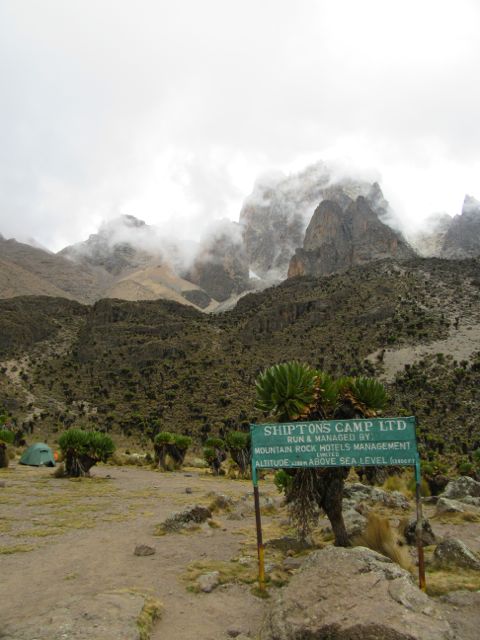
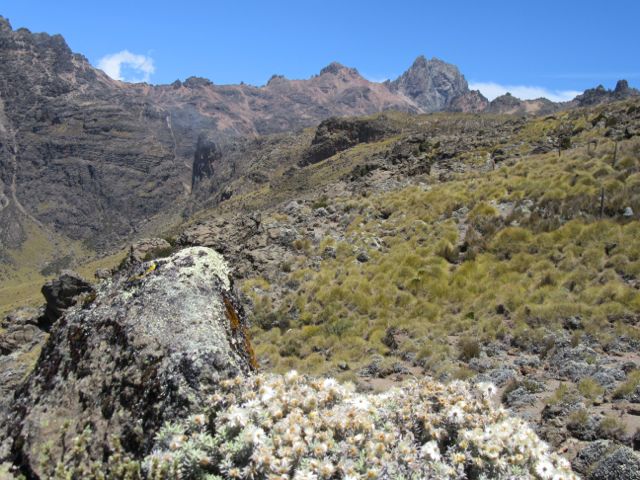
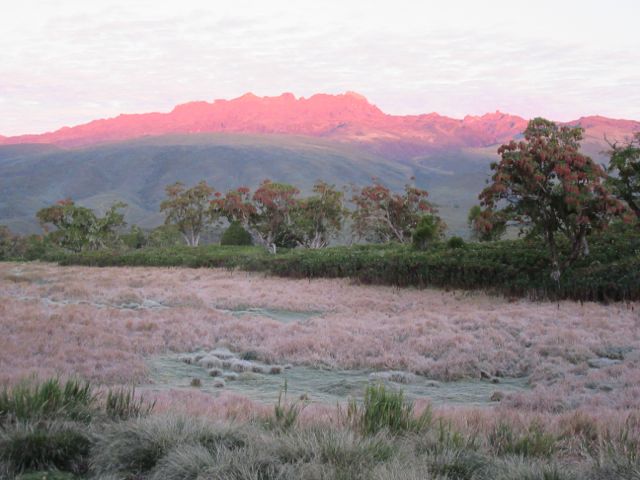
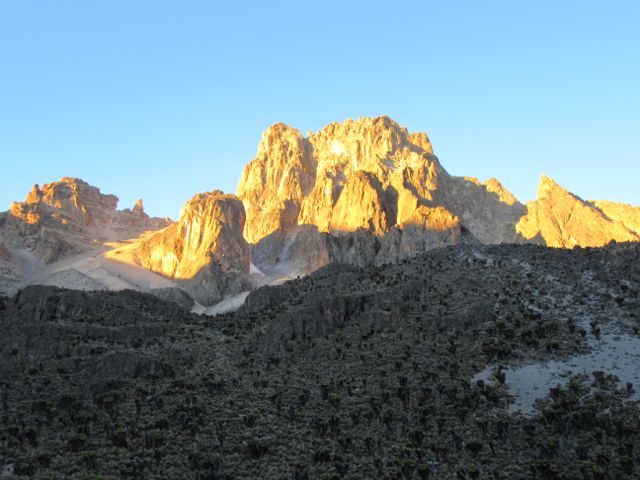
I woke up Wednesday, August 26th in a shady, cold valley with Mt. Kenya directly overhead. Mount Kenya is the highest mountain in Kenya and the second highest in Africa, after Kilimanjaro. The highest peaks of the mountain are Batian  at 5,199 metres (17,057 feet), Nelion at 5,188 metres (17,021 feet) and Point Lenana 4,985 metres (16,355 feet). Point Lelana is seen on the left here with the reddish tone. John, James, David and I had just trekked up to Point Lenana the previous day. I was certainly a bit rough around the edges and for the first time my legs were quite sore. I had pushed them like I had never pushed them before. Sore, yes they were, but they were not injured and I was ready to make the 14 kilometer (8.7 miles) hike down to Old Moses Camp.
lenana

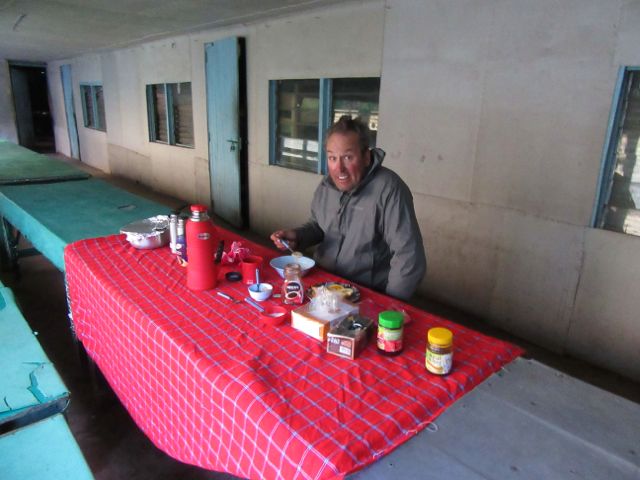
Before leaving David and I had breakfast in the Shipton’s Camp dining hall. Then we prepared our packs for the walk down the mountain.
kktt2

There were other groups at Shipton’s Camp. We met a couple from Switzerland who were going to wake up at 3am and hike up the mountain in the dark with headlamps in order to arrive at Point Lenana in time for sunrise. I admire their courage but that is an adventure I am glad to postpone indefinitely. It was difficult enough in daylight with excellent weather. There was another couple of guys from Ireland who were going to climb Batian, the highest peak. The had technical gear and ropes. The last time I saw them was about 8:30 in the morning when they were having breakfast. They seemed a bit disappointed because their guide had not yet arrived and the weather was perfect. As you can see from the photograph, there wasn’t a cloud in the sky around 7 in the morning. By 8:30, the clouds were starting to move in.

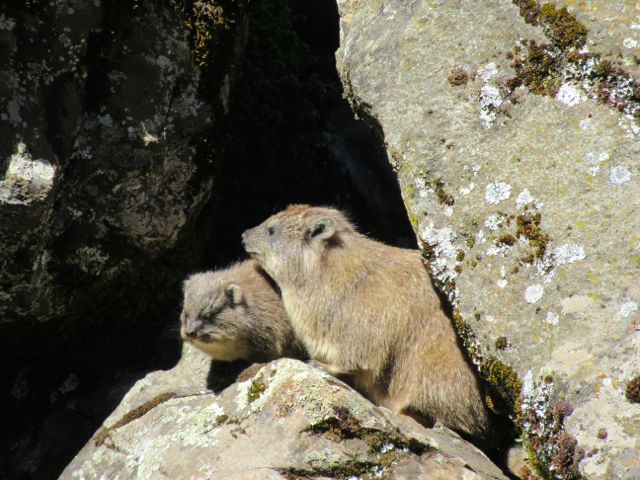
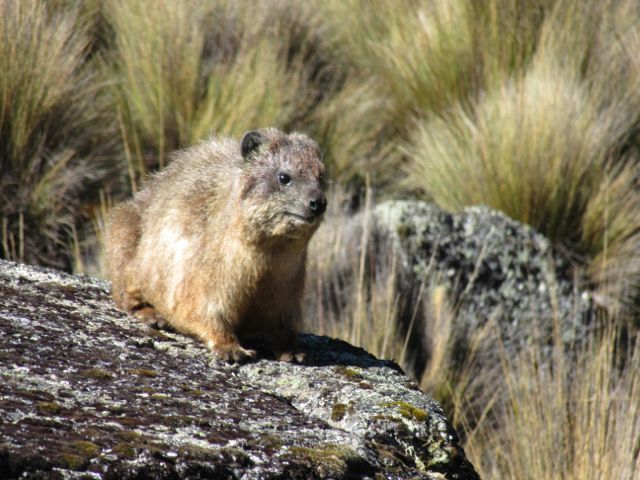
After breakfast, David and I donned our packs and started down the mountain with John and James. As we were walking, John stopped and was making a smacking noise with his mouth as he looked to the left. I turned to see this hydrax staring right into his eyes wagging his tail. This rock hydrax just might be the cutest animal I have seen all year. They are called dassies or rock rabbits in South Africa.
kktt3

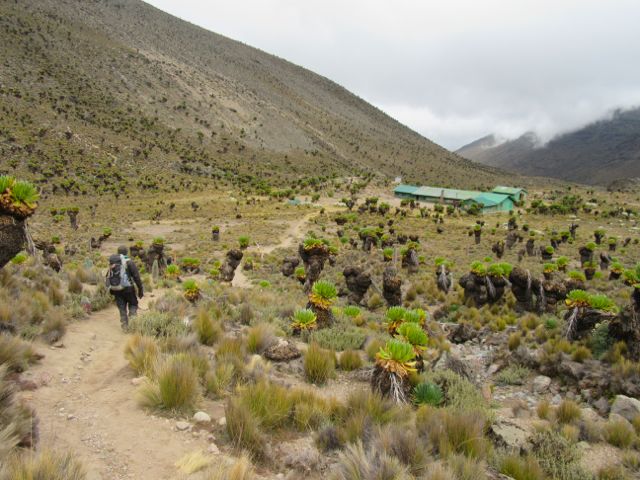
We were now in a broad valley descending steadily toward Old Moses Camp.
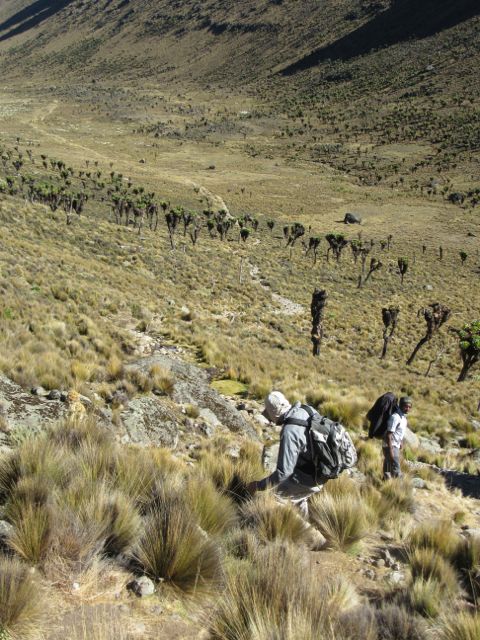
kktt4

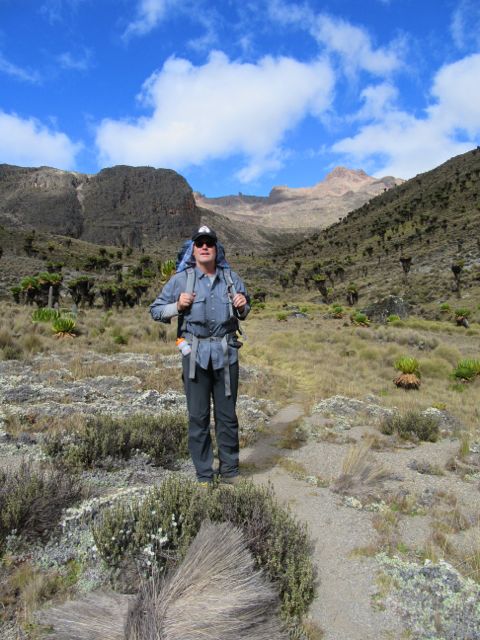
At one point I passed David, and then looked back to see the Mt. Kenyan peaks behind us.
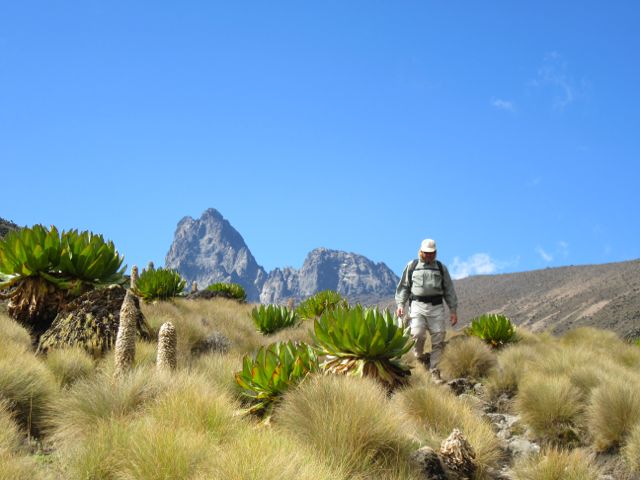
kktt5

The sun was warm but the air was crisp and cool. We passed many areas where clear water seeped from the ground making the trail wet. In certain areas, in the shade mostly, I could see ice crystals in the earth.
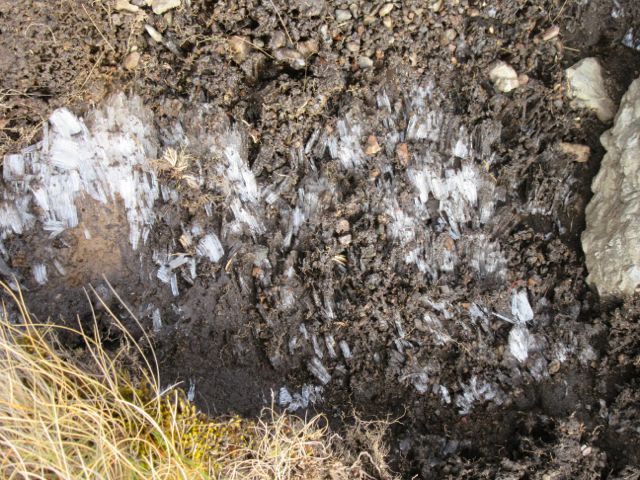
kktt6

One aspect of the trek that is important to mention is the pristine quality of the mountain. James always carried a bag and a trash pick up tool. He left any paper, which would biodegrade quickly, but picked up plastic bottle caps, bags, and wrappers that had been discarded by careless hikers.
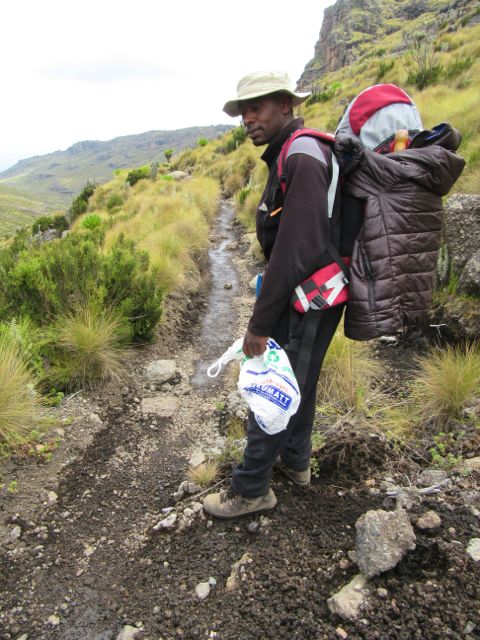
kktt7

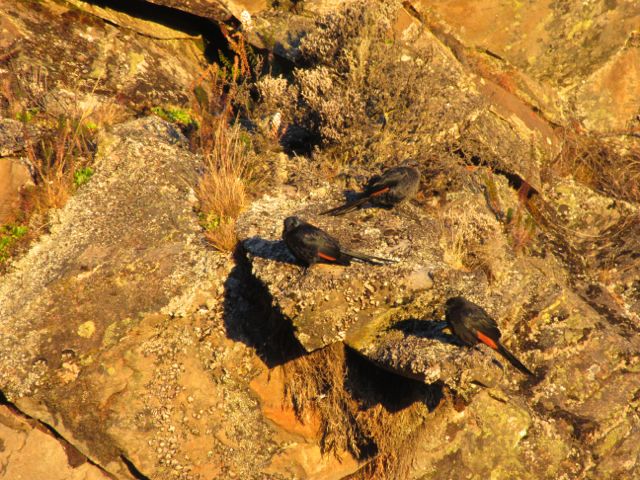
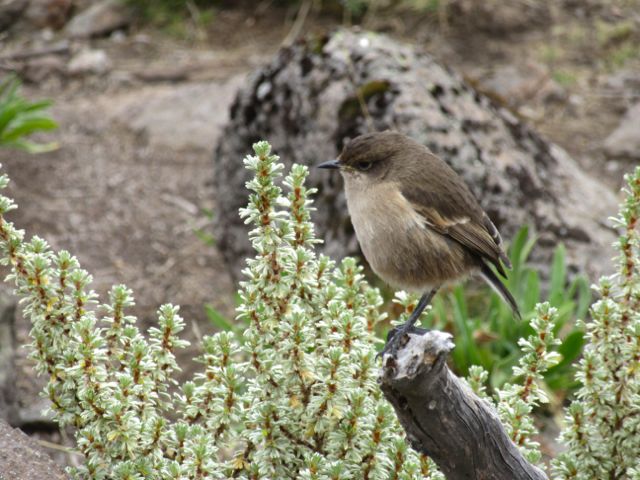
There was one particular bird we saw frequently that often made me laugh. It was a small puff ball of a bird with long legs. I was surprised it could fly.
kktt8

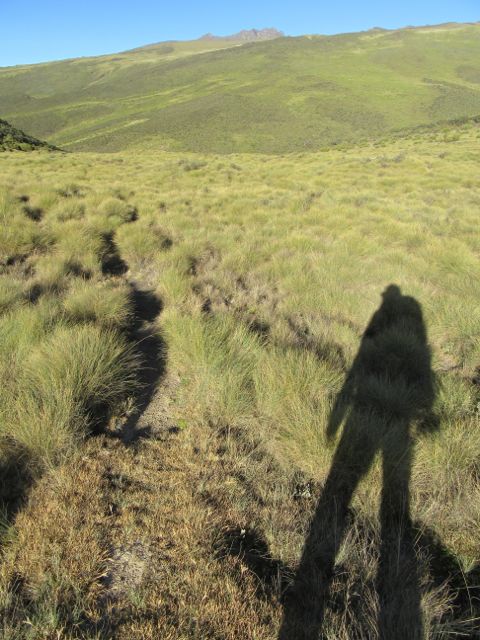
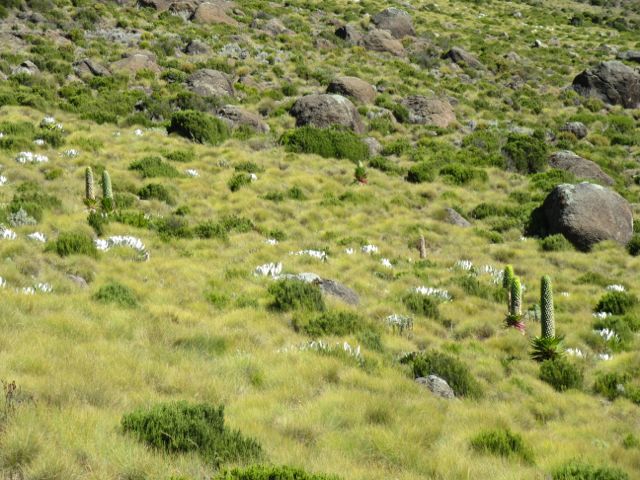
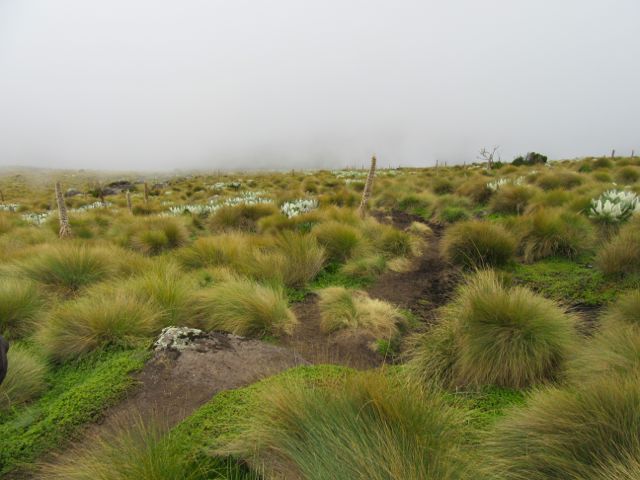
As we continued down the mountain the air became warmer with more moisture. In the morning we had been above the valley clouds, now we were moving into them. Many areas we walked through looked like we could have been in the Scottish Highlands (although I have never been to the Scottish Highlands, this is how I imagine them).
kktt9

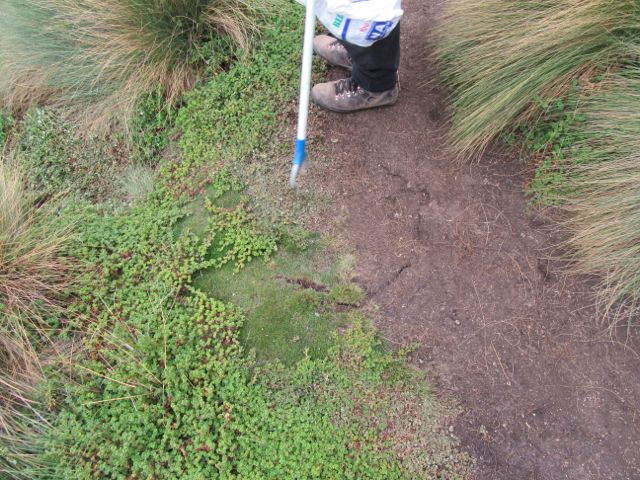
James stopped and pointed to the ground with his trash pick up tool. “Elephant. This morning,” he said. Perhaps this is a good opportunity to mention an interesting phenomenon concerning the language. Kenyan English is heavily influenced by British English and Swahili. Coming from the British side, Kenyan’s do not pronounce the “R.” Girl would be pronounced “gul,” hurry is distinctly two syllables “Huh-ree.” While staying at Kongoni Camp I looked up at the menu on the chalkboard and it read, “Calmalized Onions.” The person who wrote the menu simple spelled the word as he or she would say it. Swahili on the other hand is spoken with staccato bursts. I was listening to the television on in the other room, perhaps a news program, and it sounded a lot like Spanish from Mexico. American English in comparison sounds sluggish and slow, much like a Southern drawl sounds to someone from New York or California.

I noticed when I spoke normally to Kenyan’s they just didn’t understand what I was saying. My normal way of speaking has even started to sound odd to me when I listen to myself from the Kenyan perspective. That is what I have found myself speaking in staccato bursts without the R, and using few words. I have heard David doing the same thing when speaking to James or John. It simply makes communication easier. If my friends or family from Tucson were to be able to pop in on a conversation they might think I was crazy. All I can say is that it makes sense here. So I repeated to James, “Yes, James. Elephant. This mo-ning.”
kktt9a

I kept a look out for an elephant but we never saw one. They move quickly and the area we were covering was vast.
kktt9c

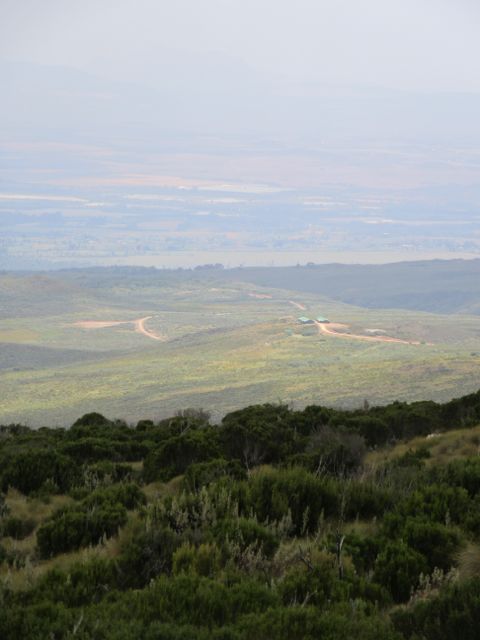
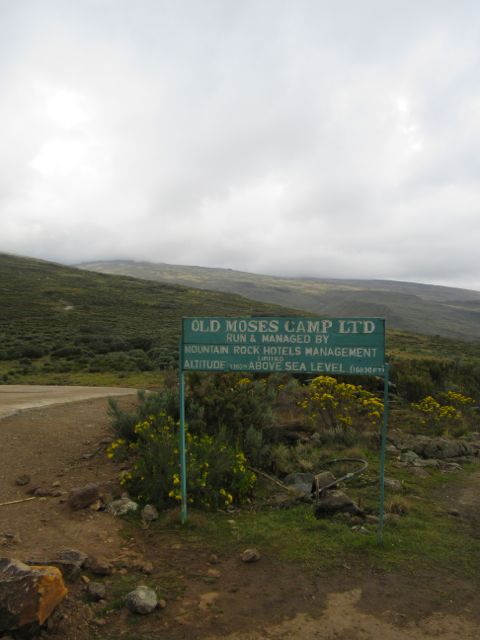
Off in the distance we could see Old Moses Camp at 3,400 meters elevation (11,155 ft), and by 12:30 or so we had arrived. We had lunch and settled in for a relaxing afternoon. I walked around a bit then napped in the afternoon, giving my body a chance to recover.
kktt9d

kktt9e

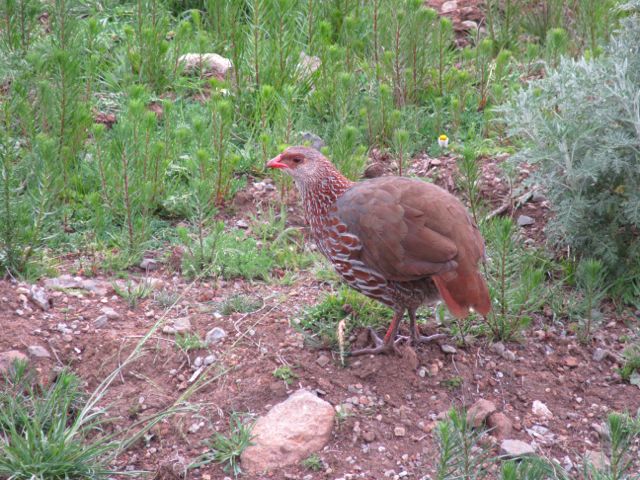
I saw several flocks of this bird, moving mostly on the ground looking for insects and vegetation, and I believe it’s a Jackson’s Francolin (Pternistis jacksoni).

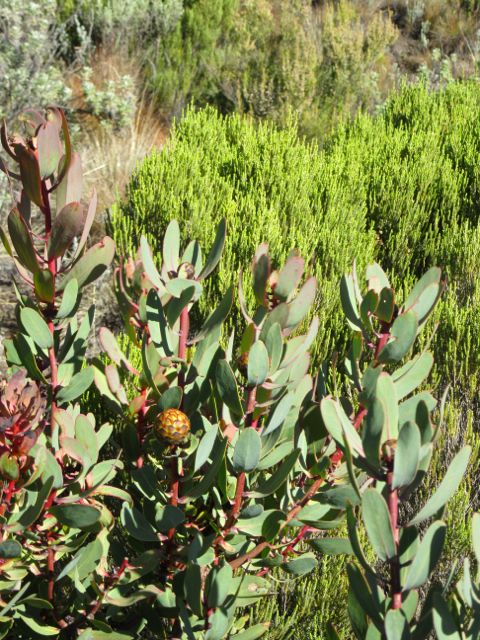
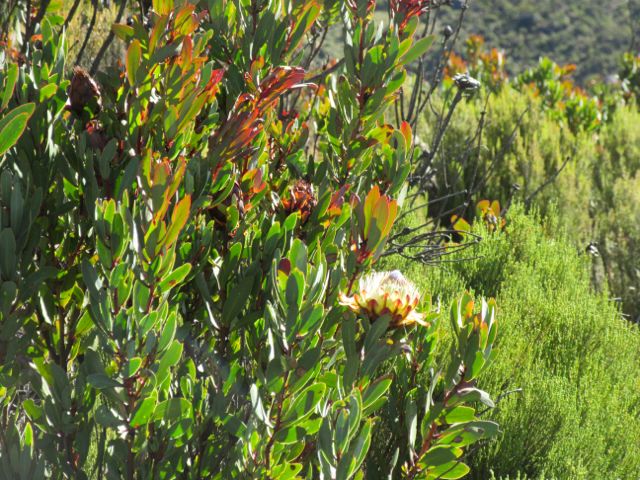
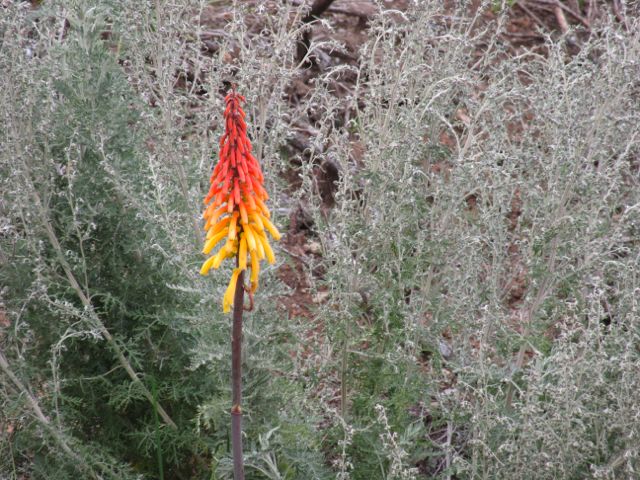
James called this colorful plant the Red Hot Poker.
kktt9f

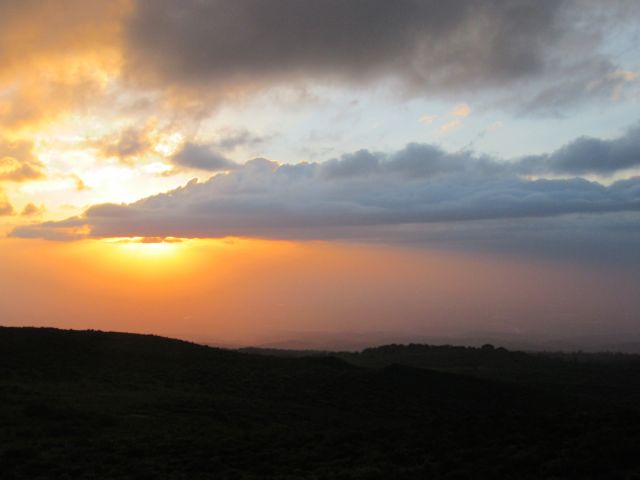
There was a small store at the Old Moses Camp and David bought us a couple of Tusker’s. There is a tradition called the Sundowner, from the British Colonial days, which is to have a cocktail or beer as the sun goes down, preferably in a spot where there is wildlife. David mentioned that many safari camps have balconies off of the rooms near a waterhole, where guests enjoy their cocktail at sunset. Many of these camps have been established for decades and are scattered about mostly to the south, west, and east of Nairobi. There are so many, I could not name them all, but some of the more well known are Tsavo, Hell’s Gate, Massai Mara, Amboseli, Ruma, Nderi, and of course the Serengeti, which is in Kenya but mostly to the south in Tanzania.

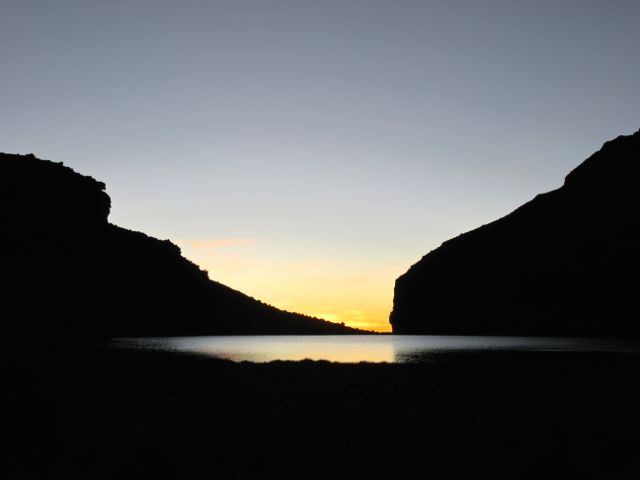
As the sun descended in the western Kenya sky, I could feel that our adventure was coming to a close. The air was warmer now, easier to breath, with the moist herbal smell of juniper and witch hazel. I had made a friend in David. He had done the trek, in part in remembrance of a close friend who had recently passed away. I had done the trek as an introduction to a new chapter in my life in Kenya, perhaps for a year, maybe longer. Tomorrow we would wake and walk down the road a couple hours to the Sirimon Gate, at the edge of the park.
kktt9g

In to Africa: Day 4

Once again, I laid in my sleeping bag slightly cold waiting for the first hint of sunlight. As I exited my tent, this is what I saw.

kttt1

I walked around in the cold golden glow of this magical mountain. Even the birds were chilled and didn’t seem quite ready to move yet.

kttt3

This hyrax seemed a bit out of sorts.

kttt4

At breakfast I was talking with one of the porters and he said that Day 4 was going to be easy. He said it was going to be a two hour hike up to a junction, then 20 minutes to Point Lenana. Point Lenana is the third highest peak of Mt. Kenya at 4900 meters (16,076 feet). Then he said we’d coast down to Shipton’s Camp and be there by noon, no need to pack a lunch. I don’t know if he was joking, lying, or seriously mistaken. Maybe he was talking about his day, because the porters did not ascend to the peak. They hiked up to a lower junction then headed down to Shipton’s Camp and were there by noon. We had a much bigger day planned but did not know it.

kttt5

We left Lake Michaelson at around 8 in the morning. First, we had to ascend back up to the trail we had left the day before at 4200 meters (13,780 feet). The picture above was taken after we had done that, and there was a broad valley with a gentle slope, punctuated by very steep sections. The air was getting seriously thin at this point.

Very high altitude is defined as 3,500–5,500 metres (11,500–18,000 ft) and we were right in that range. The lack of oxygen is sensed by the carotid bodies, which causes an increase in the breathing rate, in other words, hyperventilation. In the attempt to gain more oxygen the body breaths faster, and exercise exacerbates this effect. The heart is likely to beat faster and many people develop nausea, unusual tiredness, headache, lack of appetite, or have difficulty sleeping. I definitely had minor bouts of headache and took ibuprofen to alleviate the symptoms. I sometimes felt lightheaded and even experienced some ataxia, difficulty in walking a straight line. When that happened I usually just had to concentrate to keep my pace and stay on the trail. I made sure to drink a lot of water to help the body rid itself of toxins.

But even though my body was constantly struggling to adapt to the conditions, I was also in awe at the stunning beauty around me. I was passing through a truly incredible environment that relatively few people ever see. David and I asked John if local people ascended the mountain or at times lived on Mt. Kenya. John replied that Mt. Kenya was considered the Mountain of the Gods and was off limits.

kttt6

We kept pushing up steep grades, one after another. To say it was physically demanding is an understatement. John and James made sure we were making progress and kept the right amount of pressure up. Finally we reached a junction about 150 meters below the summit and were able to drop our packs. I was surprised, however, and not pleasantly so, that at that point it didn’t seem to make much difference. Walking without my pack was seriously difficult. After six or eight steps I was winded. If I tried to go too fast I simply had to stop to catch my breath.

up

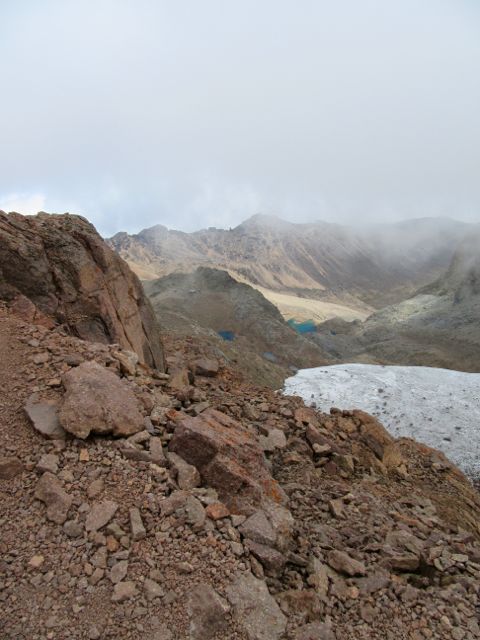
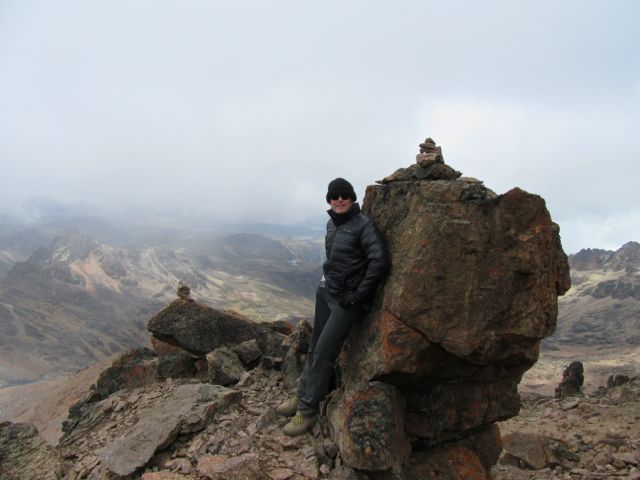
The last 50 meters or so involved what I would call scrambling over and around large rocks. Above you can see David and James making their way up about 10 meters below me. If you look over David’s left shoulder you can see a lake far below. That’s how steep it was. In addition, it was cold. All this, and we had excellent weather the whole trip. It took about an hour to do the 150 meters up the final push, but we did it. I could look down on the other side of the mountain at a glacier and lakes below.

kttt7

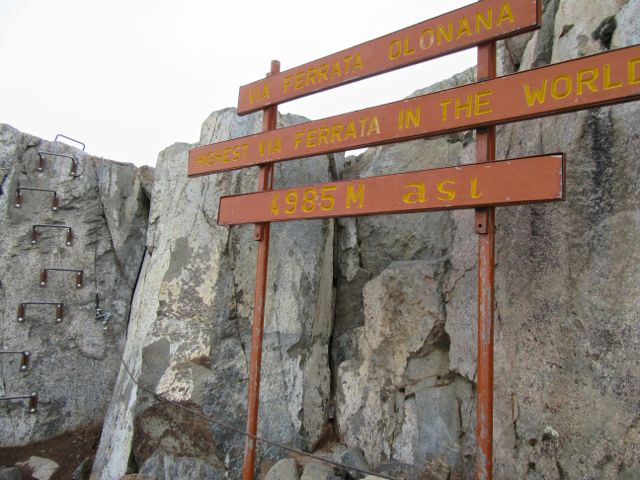
One added perk was that Point Lenana has the highest via ferrata in the world. A via ferrata is a series of guiding cables and permanent steel ladders to assist the hiker to the peak. Mt. Kenya has two higher peaks that require technical climbing skills, ropes, and gear. I am more of a hiker than a climber, so the via ferrata was a welcomed feature.

kttt8

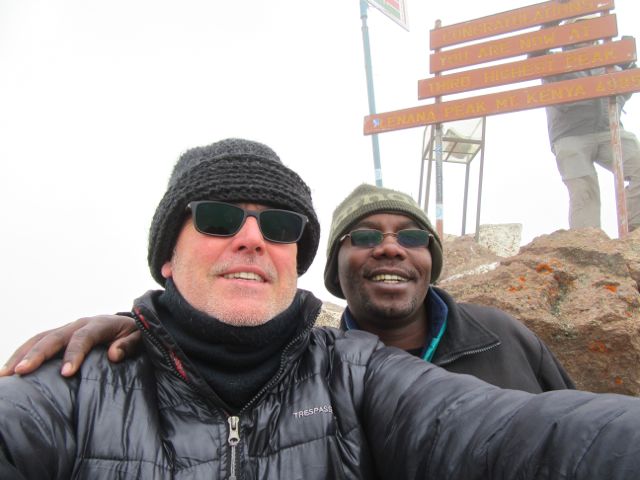
But you know, we did it. David and I climbed a very high peak that was quite challenging with the help of John and James.

kttt9

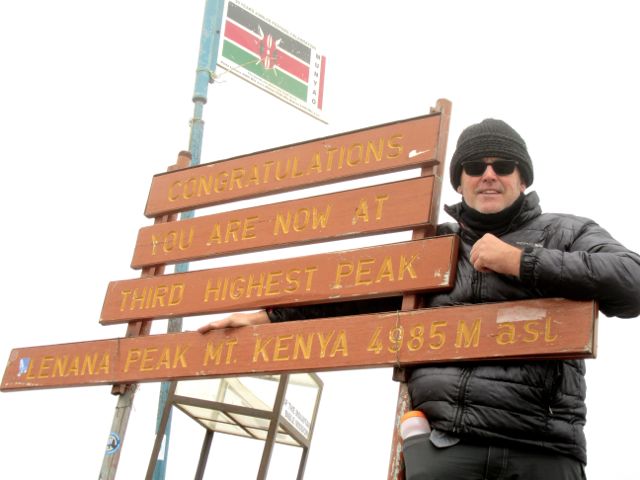
I could hardly believe we were there and my head was spinning a bit, but we did get pictures to prove it. My smile was genuine. I was very happy to be at the top.

kttt9a

We couldn’t have done it without John and James, there is no doubt of that.

kttt9b

But the challenge was not over. I remember John saying that the climb was more difficult but the descent was more dangerous. We had to watch our step on the way down because one slip could lead to a serious fall. Fortunately, we took our time, watched our step, and made it back to the packs.

For me, however, one of the most difficult parts was still to come. From where we were on the mountain, and I did not know this at the time, the most direct way down (without a lot of backtracking) was straight down the mountain. It was very very steep, and many areas had loose rocks. Point Lenana to Shipton Camp is a 700 meter elevation drop and we did it in an hour straight down a ridge. John showed me a technique that I called the Charlie Chaplin walk. It involves shuffling with your heels together, toes apart, taking tiny steps. If I began to slip the other heel was right there to keep me from falling. It worked beautifully for John, and for me too in the not-so-steep sections. But at my weight of about 200 pounds, in the many very steep sections, the only option was to put my feet in the same direction and hop from one anchor point to another, hoping the embedded rock or tiny not-as-steep section would halt my descent.

My thighs were burning and for the first time in the trip I could feel blisters forming on my feet. At one point, about three-quarters the way down, I looked over at James who was sitting down with his pack on watching me struggle. I said, “Why did you take us this way?” He replied simply, “Mlima.” Translated that means “Mountain.” I understood immediately and relaxed. A few minutes later when I was getting seriously tired, John looked over at me and said, “Concentrate, you are almost down.” The picture below was taken as we approached Shipton’s Camp after the difficult descent and the trail returned to normal.

kttt9d

As we arrived to Shipton’s Camp I took the photograph below which might give you an idea of the steepness of the terrain and the 700 meters we did an controlled fall down the mountain.

kttt9e

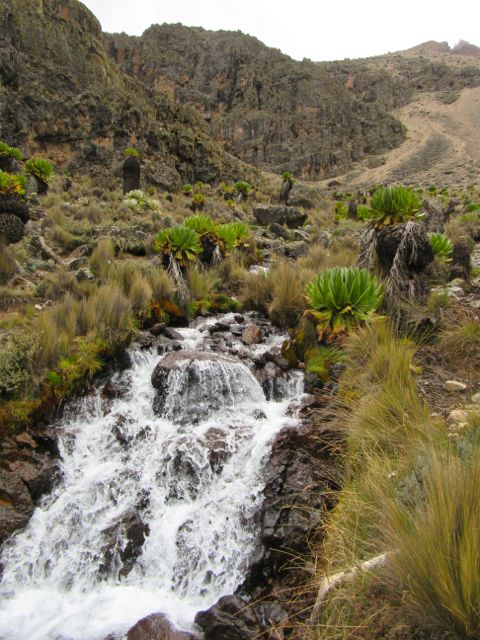
Once again, the pristine beauty of the mountain snapped me out of my funk. The photograph below is the headwaters of the Nanyuki River. The water simply flows right out of the mountain from the glacier above.

kttt9c

In to Africa: Day 3

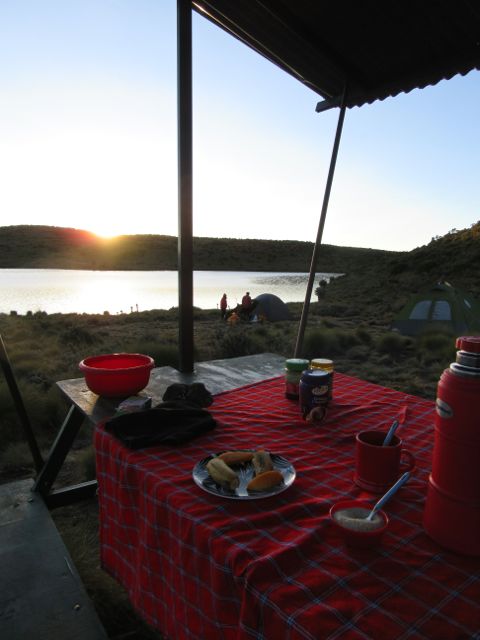
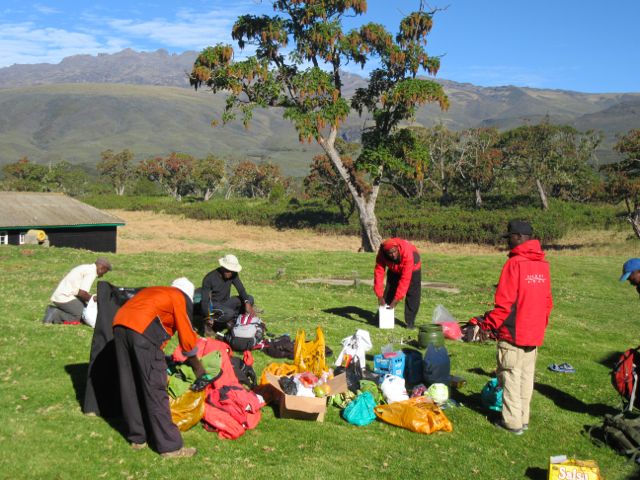
It was a cold night at Lake Ellis, elevation 3405 meters (11,170 feet), and I had another night of periods of sleep followed by hours of laying in the dark. At first light I was up and out of my tent in the cold morning air. Fortunately, others were stirring too and I was able to enjoy coffee and breakfast as the sun rose above the lake.
ktt1

Sunrise at Lake Ellis

ktt2

We did not stay long, as there would be a 8 km (5 miles) walk ahead of us. We would be climbing steadily and there was no other choice but to go pole pole, slow in Swahili. We were walking through vast grasslands with tufts up to my waist. At times I could not see my feet or the path below me.

ktt3

I was seeing plants I had never seen before. This bush had a yellow green globe that in a few days would open up into a pale yellow flower.

ktt4

ktt5

The terrain was open and seemed to go on forever. I could look back and see our progress as we ascended from Lake Ellis.

ktt6

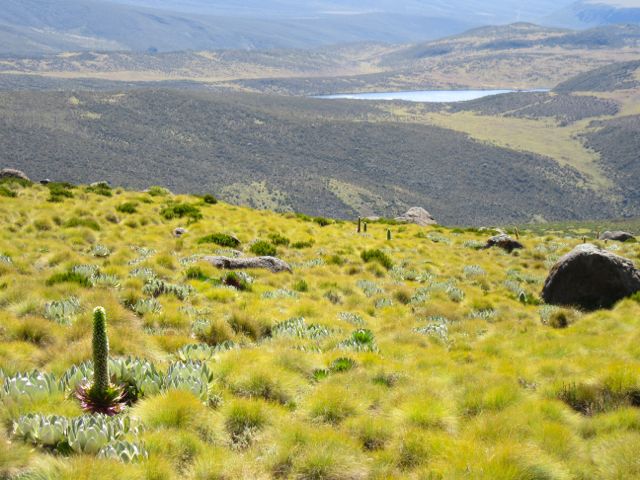
The terrain rose steadily as the flora changed.

ktt7

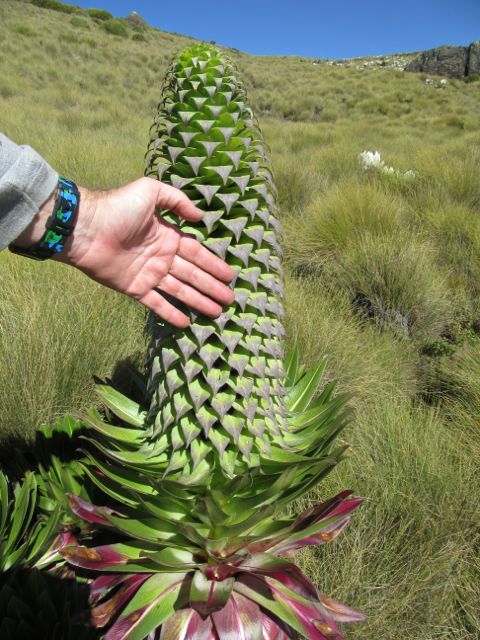
This plant, while it looked like a cactus, had soft petals.

ktt9

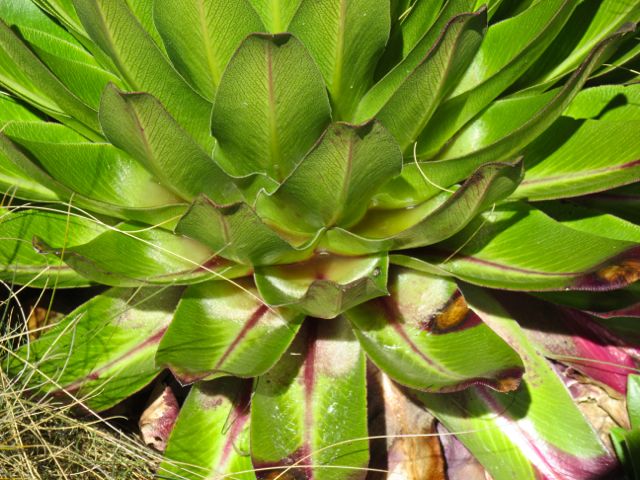
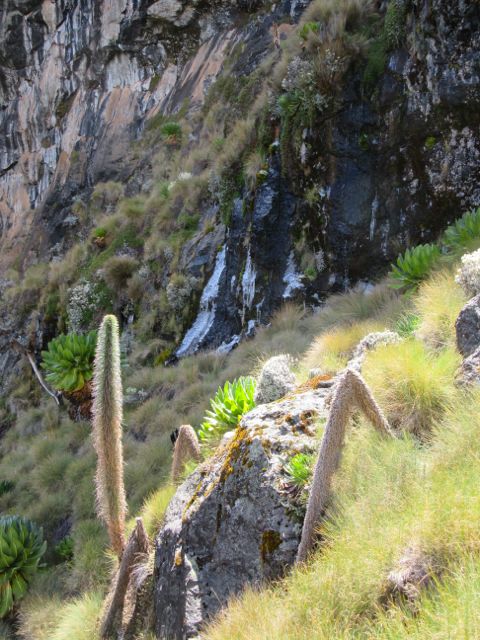
This plant collected water in its leaves. It is the giant rosette (lobelia keniensis) and was the same as the plant shown above, just less mature.

ktt9a

We kept climbing. This is the view as I looked back at Lake Ellis.

ktt9b

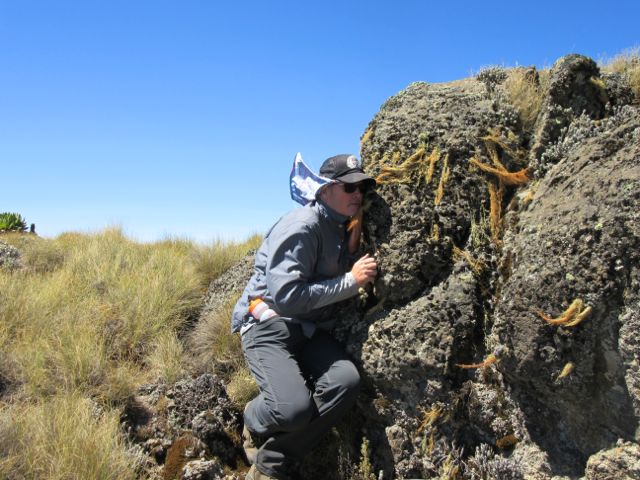
Perhaps the altitude was getting to me. John called this moss an old man’s beard, so I gently placed it on my chin.

ktt9c

The landscape became more and more bare as we ascended. We stopped at this plateau for lunch at 4200 meters (13,780 feet), Point Lenana is in the distance.

ktt9d

As I ate lunch I saw this bird hanging out in this cool plant. The leaves were as soft as feathers.

ktt9e

After lunch we began the descent to Lake Michaleson at 3900 feet (12,795 feet). John said it was important to climb high and sleep low. This is an ice waterfall on the side of the mountain.

ktt9f

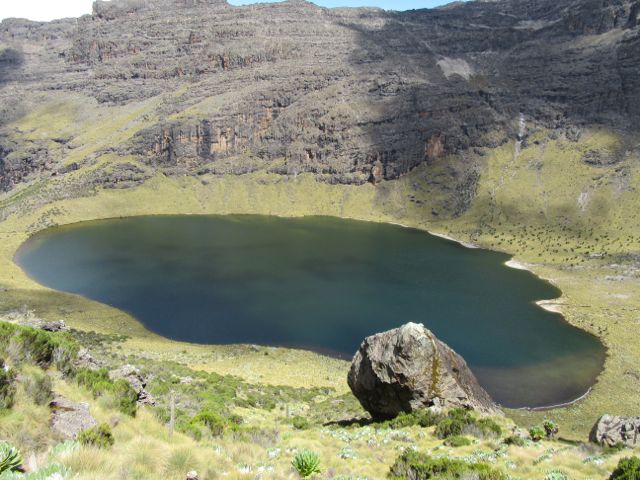
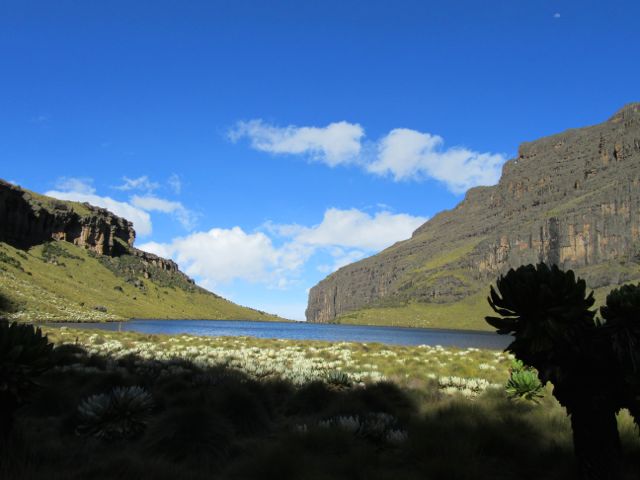
This is the view of Lake Michaelson as we sharply descended into this valley.

ktt9g

These are rock hyrax (Procavia capensis) or rock badger. There was one on a rock high above the others making a loud call as we hiked down to the lake. I thought it was a bird call, but one of the porters set me straight and showed me the hydrax that was acting as a sentry.  The closest living relatives to hyraxes are the modern-day elephants, but I was not worried about a hydrax attack.

ktt9h

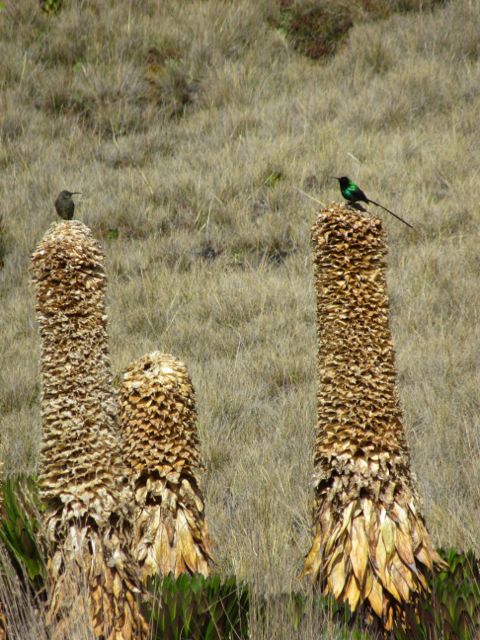
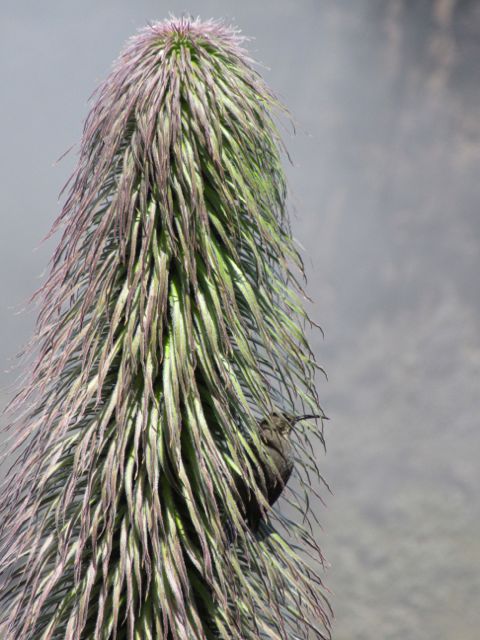
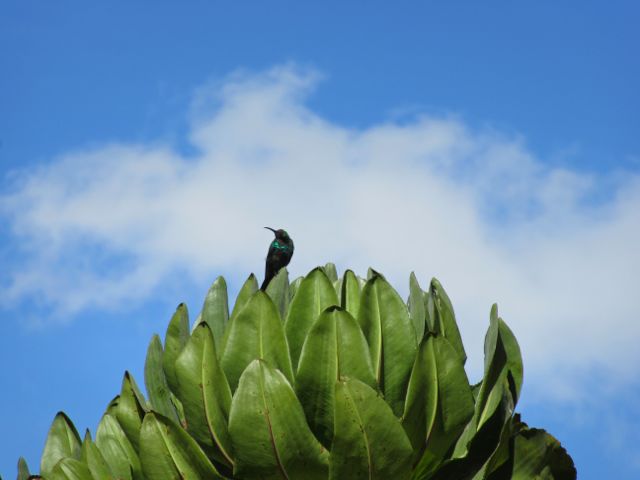
I believe this is a Red-Tufted Sunbird. It is dark with a metallic green sheen, so I don’t know why they call it Red-Tufted.

ktt9j

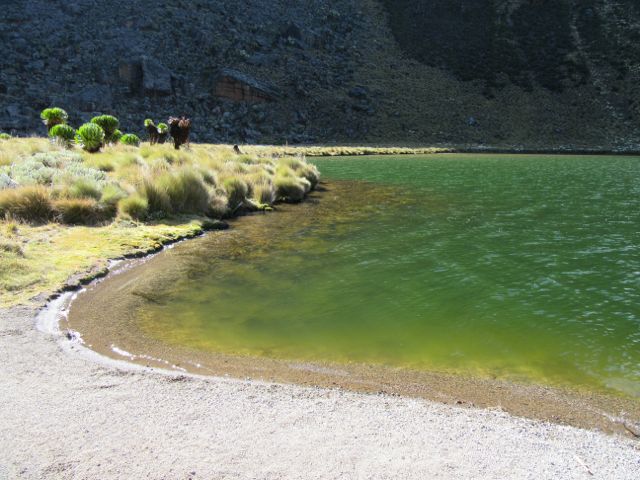
The water of Lake Michaleson was a deep green.

ktt9k

As the sun went down on Lake Michaelson, the cold set in.

ktt9l

One of the porters, in red, took some old nylon fishing line, attached a hook, and found a nearby stick to make a fishing pole. He dug up some worms nearby, and as the sun went down the trout started biting. He caught five in all, and we had fish for breakfast the next day.

In to Africa: Day 2

I awoke on Day 2 of the trek at first light. Normally I would not consider myself an early riser, but I had gone to sleep the night before at around 8 in the evening. There was no electricity, it was cold, I was tired, and my body was becoming accustomed to the altitude. I had awakened at 4 in the morning feeling a little cold but refreshed and ready to go. But it was dark outside and the early morning is when the most dangerous animals such as the buffalo are out grazing. I simply had to wait in my sleeping bag in the darkness, alone with my thoughts, for first light.

Finally it came. I could see the yellow orange glow entering the windows of the cabin. It was 6:15 in the morning. I put on my clothes along with a jacket, tubular scarf called a Turtle Fur, and a wonderful knit cap made by my friend Lisa Healy. I opened the door of the cabin, looked around, no buffalo. I then walked the perimeter of Chogoria Camp being careful to note any sign of an elephant or buffalo. Nope, none of the dangerous animals were anywhere to be seen. I did see a group of skittish Water Buck on the other side of the meadow, but they scattered within minutes of seeing me.

kkt1

The Orange Morning Light of Chogoria Camp

As I walked around one thought that came to mind is, wow, this looks a lot like Tucson. I came all the way around the world to a place that looks like Tucson. The one big difference is that it was quite cold, not unlike Tucson on a winter morning. So, actually that was a similarity too. I looked up at one of the cabins and a man was waving at me. I approached. It was Charles, the handsome guide for the Spanish group. “Did you tell the ladies about the elephant?” asked Charles. “Yes, Charles, I thought they might want to know about the elephant attack yesterday. You all will be walking down to where it happened,” I said. “They are scared, really scared,” said Charles.” “Sorry, Charles, I did not mean to scare them, but I thought they might want to know.”

I headed back to the cabin and tea, coffee, and breakfast was ready. I sat down with David in the warm cabin to enjoy oatmeal and an egg omelette. After breakfast I went outside and the Spanish group was getting ready to go. They had come up with a compromise where the group would walk one hour down the road and a vehicle would drive 5 kilometers up the road to meet them before the site of the elephant attack. The normal vehicle fees would be waived because of the heightened danger. The Spaniards were happy because the risk would be much lower, and they would be off to their next adventure at Lake Nakuru National Park that much sooner. I said so long to my new acquaintances as they headed down the mountain.

I had to turn my attention to the task at hand. It was time to get my pack ready for the first day of hiking. My pack was filled with one moderately warm sleeping bag, one light sleeping bag, clothing, a rain jacket, water bottles, head lamp, and toiletry items. I estimate my pack to have been about 14 kilograms, or 31 pounds. The porters would carry the food, water, tents, and cooking utensils. I am used to backpacking in Southern Arizona and California with family or friends, where we carry everything needed for the time away from home. It was quite a luxury to have someone else carrying the heavy stuff, and not exactly what I would have opted for given the choice, but that was the way things were done with Kenya Treks.

kkt2

I had found Kenya Treks through a Trip Advisor review in the Mt. Kenya section of the website. Lucy Booth, out of London England, had set up the trip and dealt with the logistics and financial aspects. John Karumba would be our main guide and James would be the apprentice guide.

kkt3

Packs on, David, James, and I started across the meadow toward Mt. Kenya. It could not have been more beautiful, with clear blue skies, a chill to the air, with warm intense sunlight. Several times we were reminded to go pole pole, which means slow in Swahili.

kkt4

As we walked we came across a group that was doing raptor preservation work in the national park, at least that’s what the emblem stated on the side of the Land Rover. We walked about 4 kilometers (2.5 miles) and dropped our our packs at a junction. One of the porters would stay with the packs while we took some water and a pack lunch prepared ahead of time, and headed toward the Nithi waterfalls.

kkt5

We hiked a kilometer or two down a pristine stream, with several small waterfalls, then stopped at the “father of the waterfalls” as John put it. There were a couple spots where James reminded me to lean right to avoid a plunge down the cliff. I enjoyed a picnic lunch of two peanut butter and jelly sandwiches, an egg, an apple, and a boxed juice. After a short rest, we headed back up the stream to the junction. My body was not used to the increased effort, and I felt heavy and winded, even without a pack. As we climbed up the cliff and walked narrow trails with 20 meter drops, I turned to James and said, “I should lean right, correct?” “No, lean left, lean left!” James yelled, and I laughed. I thought to myself it might take him a couple days to learn to appreciate  my humor.

kkt6

Campsite at Lake Ellis

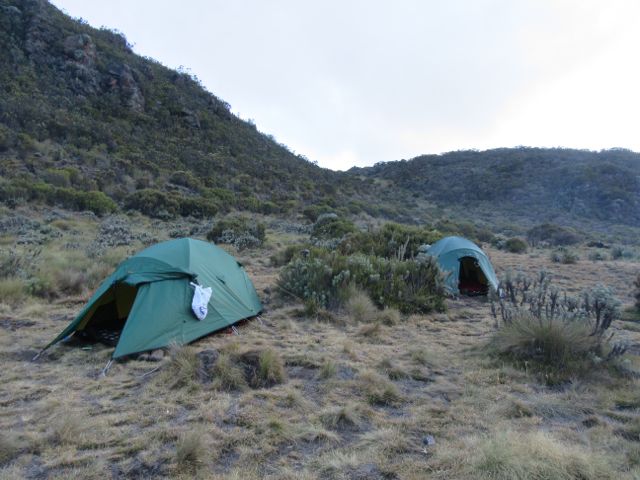
It was another 4 km to Lake Ellis, elevation 3405 meters (11,170 feet). When we arrived our tents were set up already, and tea was served.

kkt7

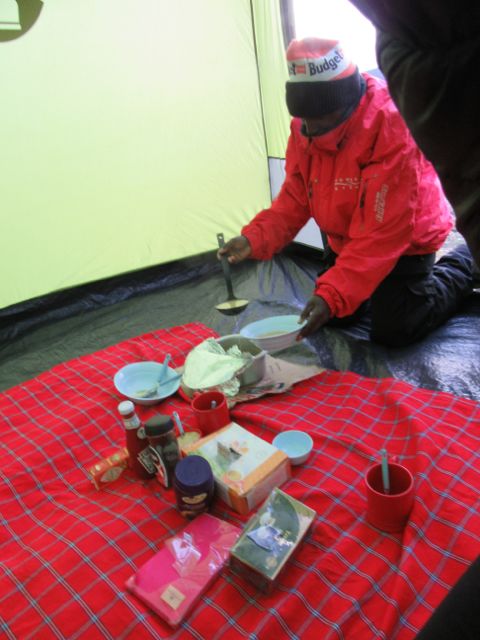
Soup after tea.

kkt8

Once finished with dinner, we gathered around a campfire. We had radio reception and James was a fan of the Arsenal soccer club. I was tired. It was only 7 in the evening and I headed to bed. I could hear the guys laughing and talking until after midnight. It would be another cold night of periods of sleep then wakefulness, waiting for the glow of first morning light.

In to Africa: Day 1

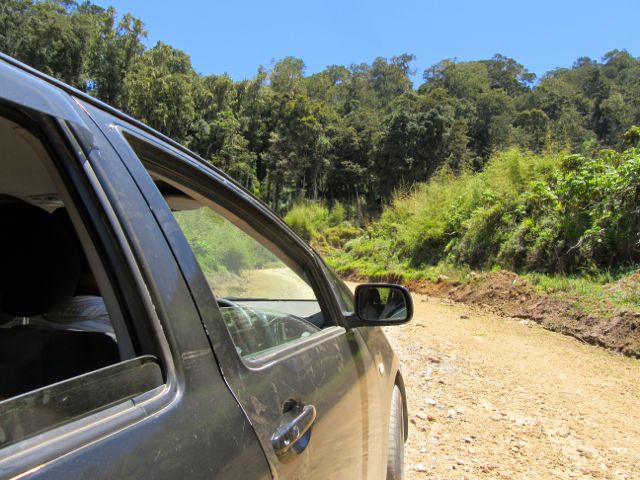
It was late morning, Saturday August 22nd, and the skies were clear. We were in a vehicle headed up a dirt road to the Chogoria gate of Mt. Kenya National Park. Despite three days of rest in Nanyuki, Kenya at 1975 meters (6479 feet) in elevation, I was feeling a bit lightheaded. It was all a bit of a blur after all. There were months of preparing for the move to Africa, an Atlanta-Amsterdam-Nairobi flight, and the time difference, and jet lag to consider. Now we were approaching Chogoria Camp at 2950 meters (9678 feet).
kt1

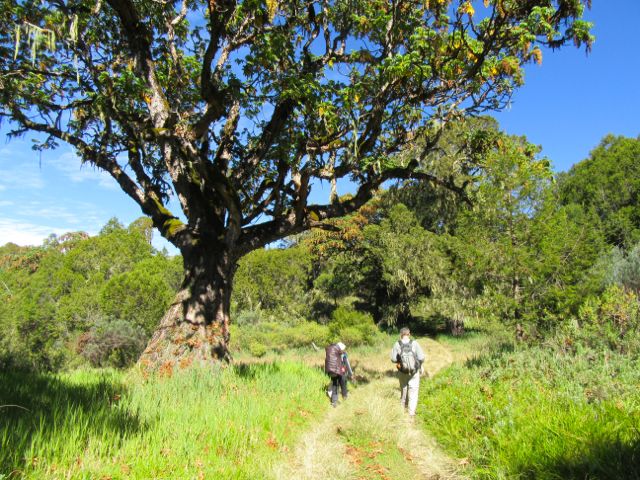
Driving up to Chogoria Camp with Solomon, John, and David.

A park vehicle descended the mountain road, slowed, then stopped. We too stopped with lowered windows. The air was cool and clean. A park ranger in military fatigues hopped out and came around the back of his truck, where I could see freshly cut wood. He was smiling, speaking in Swahili, and describing something up the road. Solomon, our driver, and John Karumba, our mountain guide asked a few questions. More words were exchanged as I tried to gauge the tone of the conversation. The ranger waved us on.

“John, what did the ranger say?,” I asked. “Oh,” John replied, “He just wanted us to know that an elephant had knocked down some trees up the road. They cleared a path for us. He didn’t want us to worry. Past the trees the elephant killed a man and he is laying on the side of the road. They are going to get the police now.” English spoken by native Kenyans is sometimes hard to understand for an American. Perhaps it is the mix of British accent with the staccato rhythm of Swahili. David, my trekking mate from Philadelphia who does real estate development and renovation said, “An elephant killed a man up the road?” “Yes, John replied, “He is dead on the side of the road, just past the trees.”

We were silent now as we continued through the forest on the smooth dirt road. Dense trees and underbrush lined each side. Just as the ranger had described, one or two kilometers up the road there were trees down. It wasn’t just a few. This elephant had knocked down large trees, eight or ten. David was an experienced traveler in Kenya and other parts of Africa. He said that elephants need to eat a lot to survive. The easiest way to get food is to knock down a tree along the road. It falls into the empty road and they eat the leaves.

The road sloped sharply to the side in the opening the rangers had made. They had only cleared enough room for a vehicle to pass. I could hear the branches scraping along the side of our car. We ran over a branch with leaves and the tires slipped, we halted for a moment, and then Solomon pushed the accelerator. I thought we might be stuck. He pushed the gas again and the Toyota station wagon gently moved forward. We were through. Now, of course, we were all looking for the man on the side of the road.
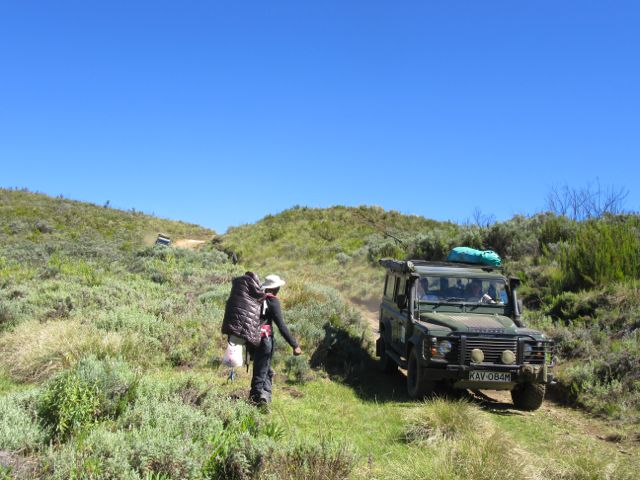
Not far ahead there were more small trees down on the left side of the road. In the middle of the trees and branches lay a man, face down on the ground. He appeared to be a local, slight of build, with short black hair. He was wearing what appeared to be some kind of a gray wrap. I wondered to myself if he was wearing the wrap or what the rangers had draped over him. His left thigh was split wide open. I could see deep red muscle and white broken bone. Blood pooled on the ground, staining the red earth even redder. While the leg injury was serious, I could only imagine what had actually killed the man. It could have been a tusk to the belly or chest. It could have been one or both of the elephants front feet crushing the man into the ground.

Our guide John pulled out his mobile phone and snapped a photograph. David was sitting on the side of the vehicle closest to the man. He voice became tense, “Okay, there’s nothing we can do, let’s get moving.” Solomon put the car into drive and continued. “What was the man doing out here all alone?” I asked. “He could have been a poacher or a honey collector,” Solomon replied. “Or maybe he was mad. The people of Meru have witch doctors. Say you have stolen something, they can put a curse on you and you will walk around mad talking to yourself. We see this a lot.” The clear day seemed to darken as I thought about the lone walker up this road, what he might have been doing, and what he encountered. “He probably startled the elephant,” John said,  “It is important to make noise as you walk through the forest, as to not startle the elephants.”

We continued another 8 or 10 kilometers to Chogoria Gate. I read the sign, “Warning-Danger. Visitors enter this park entirely at their own risk. Keep a safe distance from any dangerous animals. They do have the right of way. Visitors are also strongly advised against proceeding up the mountain if they are not medically fit or adequately equipped.”

kt4

The Sign at Chogoria Camp

An open green glade lay before me. I exited the vehicle and grabbed my pack. My feet sunk into grass three or four inches thick. Large trees punctuated the open area, with rustic cabins at the perimeter. Several men lounged on the thick grass including the cook, porters, and James (in the white hat) who was an apprentice guide to John. One man said, “Come, enter the cabin. We have prepared a tea for you.” They showed David and me to a small room with three single beds. “Choose a bed, each of you, and put your packs down on the other. Then come to tea.”

kt2

Hanging out at Chogoria Camp

I had tea, a rich Kenyan blend with ground ginger. Then I poured more hot water and made myself a mocha out of instant coffee and what was labeled Drinking Chocolate. “Time to rest,” a man said. I joined the group outside in the warm sun. I looked across a vast meadow to the mountain. I tried to sleep but sleep was impossible. As I lay there with eyes closed I thought to myself, “I am in Africa. This is Africa.”

kt3

Resting on the Grass, Looking at Mt. Kenya

I walked over to James, who sat resting but was clearly awake. James and the rest of the group had arrived earlier, and had missed seeing the dead man on the side of the road. They had heard about it though. “Are elephants the most dangerous animals here?” I asked. “No, he replied, “Buffalo are more dangerous than elephants.” I looked at the grass around me at what appeared to be scattered piles of cow dung. “Are there cows around here?” I asked. “No, that is buffalo dung,” he said. “They come through here at night. If you leave the cabin for any reason at night, be sure to look around with your torch before stepping foot out the door.” “Thank you for telling me,” I replied.

I thought back a conversation that I had with John on a hike we did two days earlier. “John,” I said, “I have a question. I am from Arizona which is a wild place and has some dangers, like the rattlesnake for example. What are the dangers here I should know about? I am not afraid. I just want to know and be prepared.” “There are no dangers here,” John replied. “No dangers,” I repeated dryly. “There are no dangers here, you will be safe,” he said. I wondered to myself if this was a cultural difference. I had already seen a dead young woman on my first day in Kenya, probably struck by a vehicle as she walked on the side of the road. I knew there were dangers. There is risk in everything, I thought. The question is the level of risk, and how prepared I would be to deal with the risk.

I went back to my grassy spot in the shade of a large tree. As I closed my eyes, I heard voices approaching from across the grass. “That’s Spanish,” I thought to myself, “Spanish from Spain.” In my early twenties I had lived in Madrid for a year studying the Spanish language, literature, and history. One man and three women walked toward the cabin next to ours and put their packs down. They looked tired. “Are there showers, we heard there were warm showers?” the man asked a guide. “Yes, inside,” the guide replied. He was a strong, tall black man with an air of confidence. They sat on the grass while one women entered the cabin to take a shower. Another woman smoked a cigarette.

As the sun descended in the west toward Mt. Kenya, James offered to take David and I on a short walk. “There is a place we might see some wildlife,” he said. We exited Chogoria Gate and descended the road, the road that led toward the elephant. I found myself looking into the bushes, looking for an elephant, even though we were miles away from the elephant that had killed the man. “What will happen to the elephant?” David asked James. “The other elephants will smell the blood of the man on the elephant. He will be rejected from the herd. He might die on his own. If the rangers find him they will shoot him, because once he has killed a man, he might kill again,” James said. David looked up and to the left into a meadow, “Look, a herd of Water Buck.” The Water Buck were skittish. They immediately noticed us from a distance of about 100 meters. Some raised their heads while others cautiously moved slowly away.

kt5

Water Buck

We continued down the road. James looked down at an animal print in the dirt. “What is that? David asked. I quickly replied, “That looks like a baboon print.” On our walk days earlier James had pointed out a baboon print and that was the only thing that came to mind. I wondered to myself why I had answered when I obviously did not know anything. But maybe just maybe, I thought to myself, I could be right. I looked to James for the answer. “A baboon has the hands of a man, just smaller. This is not a baboon print. This is the print of a leopard, and it is fresh, within the hour,” James stated confidently. Look at the crisp outline of the pads and the clear claws. “Within the last hour,” he stated again. I looked over at the bushes.

kt6

Leopard Print

We returned to camp and our neighbors were outside sitting in the grass talking. “Hello. Where are you from?” I asked. We are from Barcelona. This is Emilio and I am Alicia. Ilia is from Bilboa and Carmen from Asturias. “I lived in Spain many years ago and loved it,” I said. I switched to Spanish, as I was missing speaking Spanish, although I had only been less than a week since leaving Tucson. We spoke in Spanish for awhile, then switched back to English. I asked about the trek up the mountain. Alicia said, “It was hard, but beautiful. I vomited going up and my legs were, how to you say, tight and painful.” “Cramping?” I asked. “Yes, I think so. And look at my hands,” she said. She held out her hands, palms down. The skin was red, swollen, and blistered. “Be careful with the sun,” she warned. And then she looked at me beaming, “But it was so beautiful it was worth all of it.” Alicia lifted her boots, “I will need new boots.” She was wearing what looked like good quality hiking boots, but there were chunks missing from the soles.”

The Spaniards had done the trek from West to East with a guide named Charles and several porters, entering at the Naro Moru gate near Nanyuki and hiking east. I had read about this way of doing it. The main issue is that it climbs very quickly, making adaptation to the altitude quite challenging. The Chogoria to Naro Moru, East to West route, allowed for a more gradual climb and more time hanging out on the beautiful eastern flank of the mountain. I asked Alicia what they had planned for the morning. She replied, “We will hike from Chogoria Camp two hours down the road where we will be picked up by a vehicle.” “Did you hear about the elephant attack?” I asked. “No, what happened? she replied. I told her about what we saw. “You might want to talk with your guide about your plan. Granted, I have only been in Africa four days. Is it a good idea to do morning walk, when elephants are most active, near where a elephant, upset and alone, just killed a man? Just talk with Charles first,” I recommended.

I heard someone say that dinner was served. I said good night to the Spaniards, and we briefly mentioned meeting later to talk more. We were served a traditional Kenyan meal in our cabin, next to a warm fire. David and I sat chatting about the day. I made myself another instant mocha. As I sat there in the warmth of the fire, I knew I was not going to make it out again.

kt7

David With a Cup of Tea

It was time to get some rest and prepare for the hike to Lake Ellis.

kt8

Enjoying a Mocha Before Bed

Final Day of Preparations

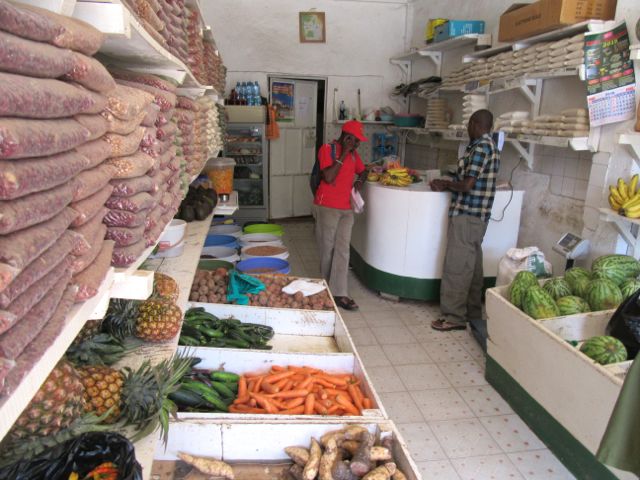
Today we are buying the supplies needed for the six day trek up Mt. Kenya. Here James and John are picking out fresh grains, fruits, and vegetables. The quality of the fresh food here is excellent and the prices are good, in part due to the mild climate and rich volcanic soil. On the trek we will have a cook and porters who will carry the fresh supplies and prepare them every meal.

nany1

Before we left Camp Kongoni John looked through the stuff I have planned to take on the trek. He thought I had underestimated the cold temperatures and recommended a thicker coat and some gloves. Fortunately, this mountain town has lots of little kiosks that sell these items. Being a mountain guide gives John not only a good income, it clearly brings him respect and clout in the community. John took me to a jacket kiosk, for example, then let me fend for myself. I could tell that he was in the middle. He wanted me to get a good jacket at a fair price, but did not want to interfere with his fellow business associates. I found a decent lightweight but warm jacket and John agreed that it would be adequate. I asked the price and the store owner wrote on his arm 2500 Kenyan Shillings.

I have never been much of a haggler, but I did sell stuff at a swap meet when I was in high school and college. I usually was on the receiving end of the bargaining strategy, and one I did not appreciate was the aggressive or deprecating method. I complemented the store owner on his quality merchandise and on the fine jacket, but said that it seemed a bit expensive. I could afford 1500 shillings, I said. We settled on 1800 shillings, and now the exchange rate is about 100 shillings to a dollar, so that’s $18. I probably paid too much but felt good about it all, and I’ll gain more experience over time.

When I walk around town, I know that the local people see me as wealthy, and relatively speaking I am. In Arizona I am an optometrist that has a full-time job and decent income, but I am certainly not rich. Here I am seen as rich, and there is almost nothing I can do to change that perception. When in a bargaining situation, as in the market or in the small shops, I will be quoted a higher price. Over time, it will be my job to learn what the fair price is and smoothly negotiate a compromise.

There is one more aspect of life here that I find interesting. As I walk around town I hear people say, “Mzungu.” Passersby say it. Little kids look at me and say, “Mzungu!” By the way, it is pronounced by making the “m” sound, then zungu, where the u is pronounced “oo,” same as Spanish. Yesterday I asked John where he bought his Land Rover and he replied, “It was owned by a mzungu, then a local guy, then I bought it.” The term is not derogatory and does not mean disrespect, it just means “white person.” I asked James, “Is someone from Asia mzungu?” Yes, he replied. “Is someone from India mzungu?” No, we have a different name for people from India. “Is a black person from America mzungu?” I asked. James looked at me like I was crazy, “Of course not,” he said. “Okay, I think I’ve got it now,” I said and we both laughed.

Kenyans are accustomed to ethnic and racial diversity. Located in East Africa and on the Indian Ocean, not far from the Middle East and India, they have been trading with foreigners for centuries. Perhaps more importantly, there are 42 tribes that make up Kenyan society. Each one of these tribes has certain attributes, such as a different language, physical differences, and a propensity for certain occupations or livelihoods. Relations are peaceful now but people seem quite aware of tribal affiliations and who is from where and what tribe.

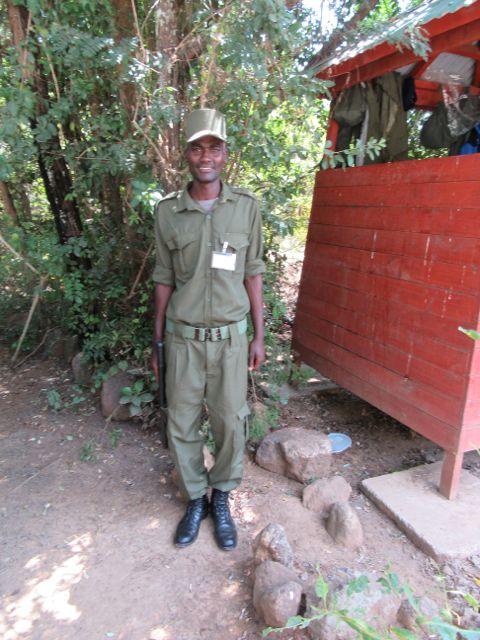
I met Peter, for example, who works as a security guard at Kongoni Camp. Peter told me that he is Maasai and I have noticed that Maasai are often hired as security guards. He tended cattle and lived with his family until his mother became ill with cancer. They tried to get treatment for her at a local hospital but did not have the money to pay. There are government hospitals but Peter told me they did not have the money to pay the bribe to get her in. Peter sold his cattle to try and help his mother, but nothing worked and she died last year. After that he took up the job as a security guard here.

nany5

I asked Peter if there was anything that I could do to help. I had told him that I was an eye doctor and he mentioned that his eyes were red and itchy. When in Nanyuki, I found a pharmacy and asked for an eye drop to help with allergies but they gave me neomycin, an antibiotic known to cause allergic reactions. I found another pharmacy and they had a good selection of eye drops. I purchased cromolyn sodium ophthalmic solution for 300 shillings ($3) and gave Peter the bottle, telling him how to use it and that he could buy it on his own if it helped him. I am not sure how affordable that might be for Peter, but at least he can try it to see if it helps.

Here is another aspect of Kenyan history and society that I find fascinating. As I mentioned in my last entry, Kenya was under British rule for 68 years. There was a fight for independence that ended in December, 1963, just months before I was born. Kenya has invited the British back and there are military compounds all over the country. Adjacent to where I am staying there is a British army training facility, and just south of Nanyuki we passed a helicopter training base. At Kongoni Camp many of the guests are young British men on leave. They sit in small groups in the restaurant eating and drinking beer, and use the pool. The local people seem to accept the British presence without any animosity, despite the relatively short 52 years since the end of the war.

I must mention at this point a disclaimer. I have only been in the country a few days, and some of my observations and impressions are most certainly incomplete, biased, or ignorant. What I am telling you is based on casual conversations with my guide John, apprentice guide James, and the employees I have met. Of course, I am not new to traveling in developing countries and working in poor areas, Honduras for example, and there are similarities.

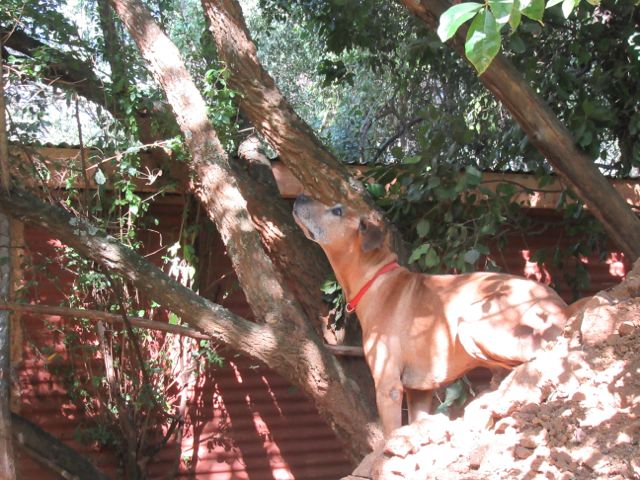
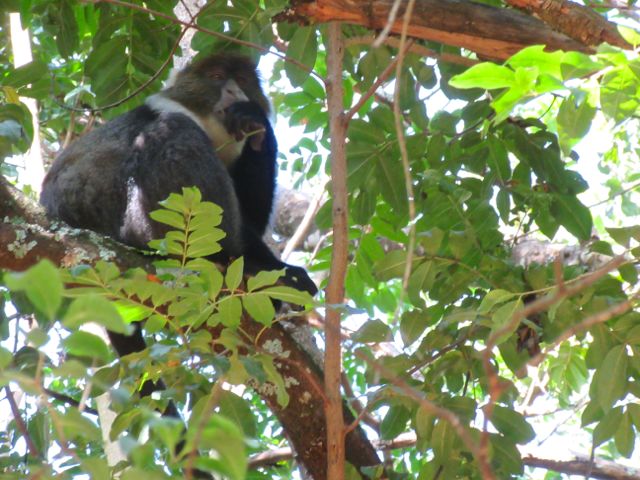
More than race or ethnicity, economic status is probably the most influential factor in Kenyan society. I am surrounded by crushing poverty. I am writing from Kongoni Camp, a rustic but comfortable lodging facility on the outskirts of Nanyuki. Kongoni Camp is surrounded by an 8 to 10 foot fence. There is a front gate manned 24-7 by armed security guards, supplemented by several roaming security guards like Peter who carry batons and a few friendly but vocal dogs like the one pointed out the monkey in the trees this morning.

monkeydog

monkey

But the main issue is not the monkeys. Theft is rampant here, mostly through non-violent crimes of opportunity. I have a locked room so I feel comfortable leaving all of my belongings here, including a couple thousand dollars in optometry instruments, the laptop computer I am using, and my personal items. I have clothing and necessities for the trek tomorrow, but also have all of my belongings for at least a year in Kenya. What I don’t have and need, I will buy. But if I were not in what I perceive as a secure situation, I would no doubt be at risk of losing everything through theft. I sense, below the surface and sometimes quite apparent, a desperation among the local people as they try to survive. By the way, on trek I will leave a bag here at Kongoni Camp with non-essential items, my laptop, and optometry instruments. No, I will not be doing eye exams up there.

What allows me to be here, especially now that I am between jobs, is a bank account with modest savings and a credit card (that I don’t like to use much). I realize that I am fortunate to have an excellent education in optometry and vision science and the fruits of decades of full-time work. It is a privilege to be here and in the upcoming year to share my knowledge of eye care with young Kenyans who too are trying to improve themselves and make a difference.

Hanging Out in Nanyuki

In preparation for climbing Mt. Kenya the main idea now was to rest, get over jet lag, and become accustomed to the high altitude. As I mentioned in the previous entry, I arrived in Nairobi Tuesday night and traveled to Nanyuki Wednesday. When we arrived to Kongoni Camp, a lodge recommended by Lucy Booth of Kenya Treks, I asked my guide John Karumba if we could take a stroll in the morning. I guess I am not very good at just sitting around.

Perhaps I should take a step back and explain why I chose to climb Mt. Kenya. I wanted to start my time in Africa with an adventure, but there were many adventures to be had here. The first idea I had was to climb the highest peak in Africa, Mt. Kilimanjaro, and some friends of mine did just that about six months ago. The issue was that Kilimanjaro is not in Kenya. Most people fly into Nairobi, Kenya, they then travel south to Tanzania around the mountain and start from there. Another factor is that everyone wants to climb the highest peak in Africa. As a result, it is quite expensive with budget packages in the $2,000 to $3,000 range, most likely with a large group of people, and that is not including air fare. From the research I did, it is easy to spend $3,000 to $6,000 on the trek.

Mt. Kenya, on the other hand, is the second highest peak in Africa and located about 150 miles north of Nairobi right in the heart of the country. Since I hope to move here and teach near Kisumu, I felt that a trek up Mt. Kenya was more my style. One added benefit is that it was much less expensive. Including full board at Kongoni Camp for three days and nights, a six day trek with guides and porters, park fees which help preserve the Mt. Kenya National Park, and transportation the cost was about $2,000, not including air fare. In addition to John, the lead guide, James an apprentice guide and several porters, I will be doing the trek with one other person, an American named David who I have not met yet and will arrive tomorrow.

nan4

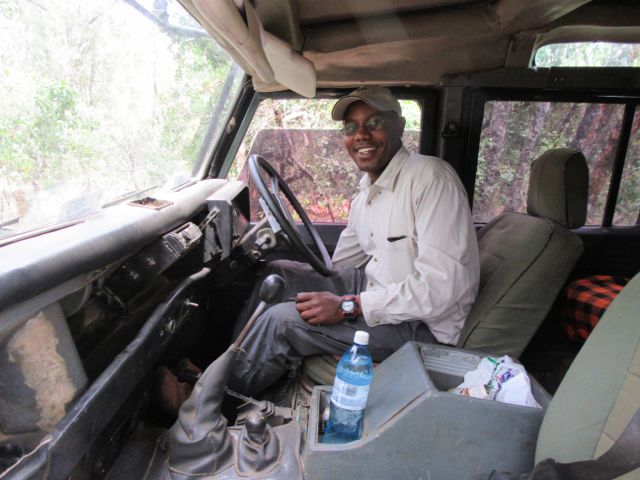
John arrived this morning at Kongoni Camp in his vintage diesel Land Rover, along with James. I asked where we were going and he said there was an interesting historic cave off in the bush about 6 miles south of Nanyuki.

nan6

We headed south past a military check point. As I mentioned yesterday, there has been an ongoing security issue in the last years involving truck loads of migrants from Somalia, which borders Kenya in the north east. Many migrants have settled in a large slum in Nairobi called Little Mogadishu. The poverty and marginalization have created a fertile recruitment ground for Al-Shabaab, an organization that has claimed responsibility for several attacks in recent years.

nan5

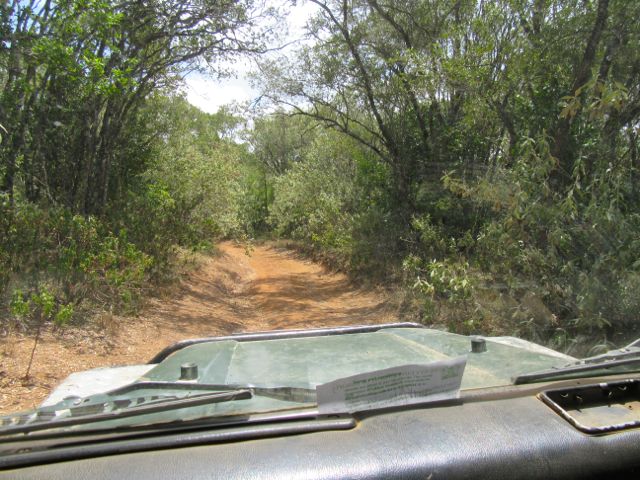
We turned east off the main road and heading into a forest on a deeply rutted dirt road. This area was wild but far from pristine. We saw sheep herders with about a hundred head of sheep, and cattle herders are often frequent the area. The old growth forest has been cut down, but the native Olive Oak and Cedar have grown back but are often concealed by dense underbrush, said John and James. It is close enough to Nanyuki that some people camp and farm in the region. It is a protected area, but not enforced, and not part of the Mt. Kenya National Forest.

John drove in a couple miles then parked the Land Rover. We then proceeded on foot. As we walked, John and James told me the significance of the Mau Mau Cave we were going to visit. In 1953 the Mau Mau fighters discovered the cave and used it as a hideout. They were fighting for freedom and independence from Britain who considered Kenya their colony. Later that year, the British Army discovered the hideout and attempted to bomb it. Their bomb missed the target but caused a partial collapse of the entrance. Kenya gained independence from Britain in December of 1963.

nan9

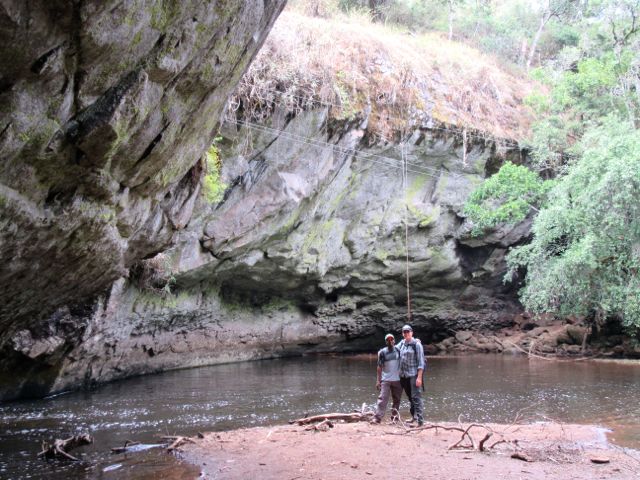
As we approached the area we heard children playing and laughing, but they disappeared as we neared. Here you can see James standing at the entrance of the cave.

nan9a

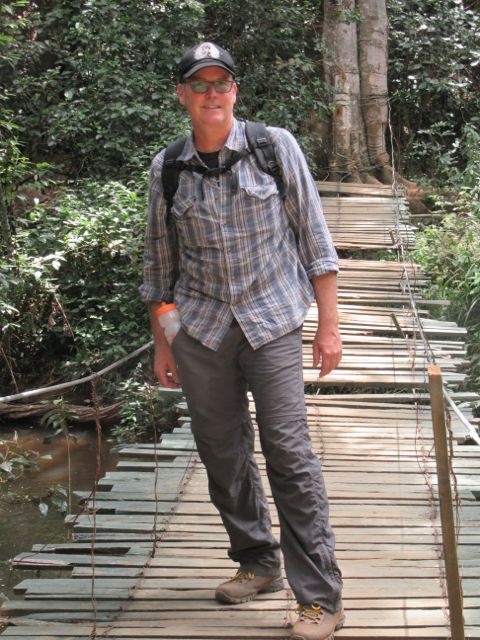
From another perspective you can James and I standing near the Nairobi River.

nan9b

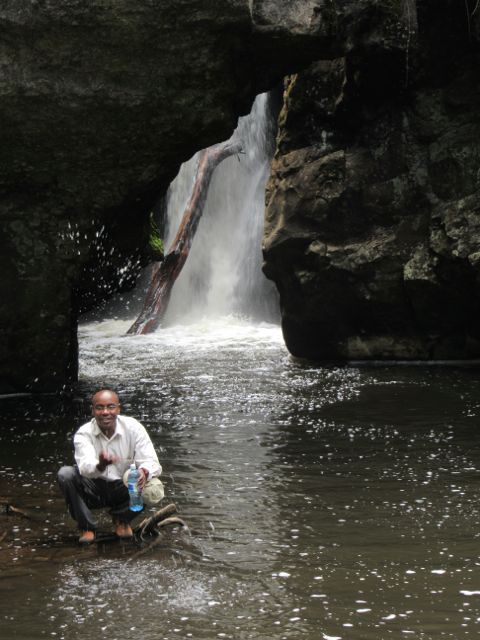
John enjoyed the water and you can see the waterfall behind him.

nan3

Sometime between 1953 and 1963 the British built a suspension bridge over the river.

nan2

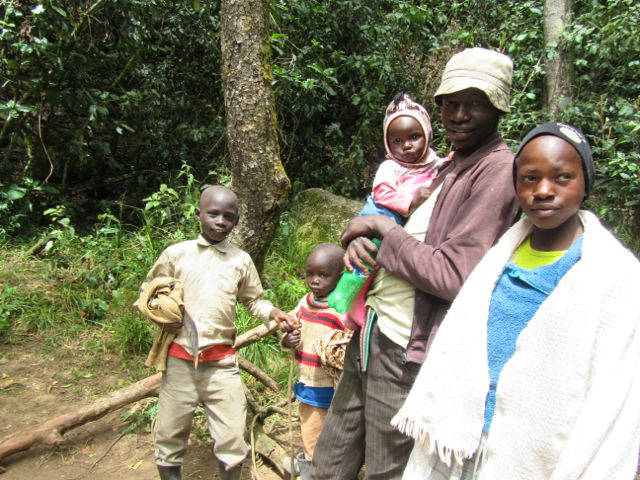
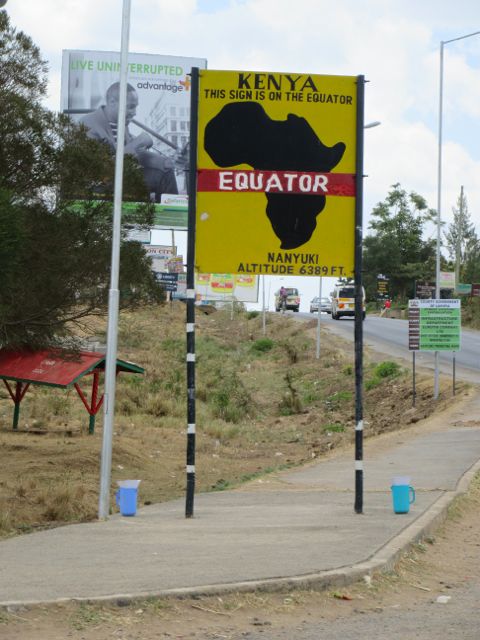
As we were leaving the children appeared from the forest to say “Jambo.” They were quite friendly and wondered why we had come to visit. John and James speculated that they lived above the cave with their parents who were sheep or cattle herders. After hanging out for a while we headed back to the vehicle. On the way back into Nanyuki, we stopped to snap this photo of the equator sign.

nan8

Kenya Believe It?

This is the first edition of what I am hoping will be many entries on my travels in Kenya. I am still getting the hang of things so will probably skip trying to include photographs today. I’ll be happy if I write something and then figure out how to publish the link on Facebook.

The last couple months have been a whirlwind of activity in preparation for this trip. I prepared a place to live in my back studio, moved in, and then worked on my house to get it ready to rent. Ben and Conor moved in on August 1st which is when I finished my last day at the University of Arizona Department of Ophthalmology and Vision Science. I visited my brother Dave and his wife Hazel, Ven and Anne (Hazel’s parents), and Ethan, Mia, and Andrew in Hawaii. I went to California give away my mother in marriage to Lanny, and see my sister Darla, nephew Sky, and niece Sarah Beth. I visited my step dad Maurice and his wife Anne in Salt Lake City.

Getting back to Tucson with almost a week before leaving for Kenya, there were many nights out with friends drinking beer and listening to live music. The most notable evening was last Saturday when Cassie and Don hosted a “Dan’s Moving to Africa:  Kenya Believe It?” Party. We drank lots of beer and splashed around in the pool for a couple hours. It certainly was the most fun I have had in a long time. I felt like a kid, and very loved by all of my friends.

Monday morning, August 17th, Don dropped me off at the Tucson Airport with three bags; I had packed a backpack for a trek up Mt. Kenya, a lightly packed day pack, and a rolling carry-on suitcase. My biggest priority was to take all I needed but be able to handle it by myself without too much effort. This was a challenge because I needed supplies for a 6-day trek, clothing, and optometry instruments that will be necessary to do my job here, that is, teach optometry. That is the reason for the trip after all.

There was the three hour flight to Atlanta, Georgia. I don’t remember much about that now even though it was just two days ago. I walked a lot as I waited for the next flight, trying to tire out my legs so that I’d be happy to sit for the eight hour flight to Amsterdam. The most notable part of that trip was the very beginning. As we were taxiing to the runway to take off, the skies let loose with a torrential downpour with thunder and lightning. We had to sit for a half hour before we were approved for take off.

Amsterdam, well, the international terminal in Amsterdam, was as expected. It felt very European, clean, and organized. The skies were gray and it was lightly raining outside, which I assume is normal weather for Amsterdam.  The only unexpected part was that there were several leaks in the terminal with buckets strategically placed to catch the water. Small sections of the waiting areas were roped off with water on the seats and floor. I still haven’t figured this out. Doesn’t it rain a lot in Amsterdam? Isn’t that why the grass is so green and tulips grow so well in the cool, moist climate? So, why all of the sudden is the roof opening up and leaking all over?

I think my favorite leg of the trip was Amsterdam to Nairobi. I was starting to feel like I was really going to Africa, with more than half of the people on the plane appearing to be African. I guess the assumption here was that most of the people in Africa that are African have darkly pigmented skin. The Dutch flight attendants were very friendly, professional, and attractive. The food was excellent, and I found out that there was no charge for red wine, so I had two glasses and a couple Ibuprofen PM’s that readily put me to sleep.  I woke up about an hour and a half before landing in Nairobi.

I exited the plane on a metal stairway down to the tarmac and then headed into the inevitable chaos of the immigration can customs stations. There were the usual long lines and a bit of jostling for position but it went smoothly, in part, because I had already purchased my multi-transit VISA good for six months of entering and exiting the country. I had nothing to declare so customs went very fast. Exiting the airport there must have been two hundred people waiting, many with signs with a name or a group printed on them. Fortunately, as I had arranged, a gentleman from the Boma Inn had my name on a sign. I introduced myself and he said his name was Jeffrey. We walked a bit through the crowd and he asked me to wait at the curb while he got the car. This was the first chance I had to look around. The air was cool and moist with scattered low clouds.

We drove for about 15 minutes through the inevitable airport traffic and headed toward downtown Nairobi. The Boma Inn was recommended to me by Lucy Booth of Kenya Treks, and it was much nicer than expected for the $160 a night charge plus $25 pick up fee. Everything about it showed simple but fine taste from the darkly stained wood, modern design with highly vaulted ceilings, and stone floors. The room was probably the nicest I had ever been in with everything one would need including wifi, television, and bottled water. I headed to the bar for dinner and a Tusker beer, and was pleasantly surprised that the $5 beer was 750ml rather then the smaller export size I had once purchased in Tucson.

After a nice meal I went back to the room, and checked my e-mail and Facebook page. This is when I found out that Tucson musician Stefan George, my friend and guitar teacher from a decade ago, had collapsed and passed away Monday. Stefan was an incredible blues guitar player and songwriter. I had seen him last in the fall when he played a benefit for the Lion’s Club at Cushing Street Restaurant and Bar. His health was beginning to fail at that time and he had recently lost his wife Lavinia. I could tell he would be leaving us soon also.

I was able to fall asleep for about 4 hours from 12:30am to 4:00am, not bad for the first night with such a big time difference. I awoke and checked my e-mail and Facebook page again. I fell asleep for an hour or so, got up, showered, and walked out to enjoy a stunning breakfast served at 7:00 am, thankfully included in the price. I walked around the Boma Inn grounds and took in the sights and smells of Nairobi, albeit a walled and guarded version. There were low clouds, lush plants, and flowers. Everything was close to perfect. Not far from the Boma Inn is one of Nairobi’s largest slums, Kibera Slum. Crime in Nairobi is a huge issue and the city is often referred to as Nairobbery. This explains the armed guards at the gate and staff patrolling the grounds.

I checked out and waited for John Karumba, a guide who works for Kenya Treks. I had researched this idea, to have a bit of an adventure before starting my year long commitment to teach optometry in Kenya. John showed up with a reserved smile and introduced himself, a soft spoken and fit man in his 30s. He explained that the driver was below in the parking lot and we could begin our 4 hour drive to Nanyuki, a small mountain town at the base of Mt. Kenya.

John helped me place my bags into the back of a small black Toyota wagon, similar to a Toyota Matrix. I met Solomon our driver and sat in the back seat. In the first minutes of our trip I realized that I will probably never drive in Kenya. The driver sits on the right, and Kenya uses the British style of roadway where the traffic drives on the left hand side of the road. It is confusing and bewildering at first.

Almost instantly everything was chaos. Traffic seemed to come from all directions as we turned onto a complex roadway. There were cars, trucks, bicycles, pedestrians, motorcycles, and three wheeled vehicles that I think are called tuk tuks. The air was full of diesel fumes, and small fires burned along the road. A few miles down the into our drive I saw a shepherd herding maybe 20 head of cattle just off the road in a dirt, grassy strip. A few miles later there was herd of 50 cattle and 25 sheep. There were markets just off the road way with people carrying chickens and baskets of fruit trying to get on the road, off the road, to the other side of the road. Pedestrians waited to cross, and then did cross running then stopping, dodging cars and trucks, in what appeared to be a freeway to me, albeit a congested, slowly moving freeway.

The road over the next 10 miles or so narrowed to a two lane highway, with all of the above mentioned obstacles. It was difficult to make progress quickly as there were frequent settlements, markets, and groups of people. Lots of people just sat near the road, on embankment or hillside, crouching, watching. Solomon expertly negotiated several harrowing passing manuevers as we encountered trucks with wobbling wheels going 15 miles per hour, and more than one horse or donkey drawn cart filled with wood, debri, or vegetables.

Every 10 miles or so there was a police checkpoint where uniformed men with machine guns had placed metal strips with 4 inch long spikes across the road way. John explained that they were looking for trucks filled with migrants from Somalia, probably headed toward the slum called Little Mogadishu, which has been a fertile recruiting ground for Al Shabab.

It quickly became clear the me that road travel in Kenya would probably be my most dangerous activity. My suspicion was confirmed when we encountered the first of several road crashes, with police and a crowd of onlookers.

Slowly and over many tens of miles the road opened up just a bit, with lush tropical hills on each side. I could see banana groves, mango and papaya trees, and lots of gardens. People sat next to the road in small kiosks selling stacks of oranges and other fruits.

There was plenty of time for conversation. I asked John what he did for fun when not guiding people up the 17,000 foot Mt Kenya. He said he was a farmer in a new government program where he planted potatoes then trees among the potatoes. As the trees grew and began to shade the potatoes, he would harvest the potatoes and then let the trees grow, eventually to be harvested a decade later. That’s what you do for fun, I asked. Yes, he replied.

Solomon asked about me and where I was from. I explained that Tucson was in the Sonoran desert in Arizona and was hot and dry. Arizona? Yes, Solomon, I live in Arizona, I said. Can I ask a question? Yes, of course, Solomon. Why do you teach children to shoot guns in your schools? We don’t, I replied. He said, “I read a story of a teacher in Arizona showing a girl how to shoot a gun and she mistakenly shot him.” Oh, I know what your are referring to, Solomon, but I can assure you that we don’t teach children how to shoot guns in our elementary schools. I went on to explain the incident and that it was a shooting range and not a school. “But why are there so many guns and why let children handle them?” asked Solomon. I don’t know, I replied.

As we gained elevation it became hotter, dry, and dusty, not unlike parts of Tucson. We were about ten miles from our destination of Nanyuki.

I saw a crowd of people on the side of the road ahead and several parked vehicles near small community with a few homes with tin roofs. People had placed tree branches in the road to close one lane. Oh no, said Solomon, she is on the ground. As we passed I turned to see a girl or young woman face down on the side of the road, the bottoms of her bare feet facing up, sprawled out in the dirt next to the road. Her head and body were covered with several brightly colored cloths. She was gone.

We drove along, quietly now, until we reached Nanyuki. Hesitatingly we talked again. There was an electric adapter to be purchased, money to be changed, and a saroung to buy for me when at camp and not hiking. We drove to Kongoni Camp where I will be resting for several days in preparation for the trek up the mountain.